Showing posts with label National Wildlife Refuge. Show all posts

Thursday, 31 May 2018

Wildlife Encounters in Florida

April 24, 2015


White Ibis
I just returned from a pretty amazing trip to Florida! This was my first *real* trip to Florida so it was pretty exciting for me! I have been to Florida two other times but both were visits to Disney World and attractions like the Weeki Wachee mermaid show and the Kennedy Space Station museum. Both times, I was well under 10 years old and I barely remember the trips... I definitely wasn't a birder yet, and we didn't visit any natural areas.

During this week-long trip, we drove and camped along the way through Florida to the keys. We camped at the Chassahowitzka River Campground, Lake Kissimmee State Park, and Curry Hammock State Park. We also visited Crystal River National Wildlife Refuge, Loxahatchee National Wildlife Refuge, Fort Zachary Taylor Historic State Park, and the Port Orange Causeway Park.

Green Iguana
Chassahowitzka wasn't especially interesting, as far as birds and wildlife diversity. However, we did find one of only two snake species we found on the trip: a Yellow Rat Snake. He was very pretty and after finding him, Ben and I walked along the roads near the campground to look for more snakes. Our only luck was a squished Ringneck Snake. On the way back into the campground, we heard some type of critter making a pretty loud racket behind a bush. As we shined a light over, a Nine-banded Armadillo quickly ran behind a tree!! It was the first Armadillo I had ever seen, and by the next day, they were added to the top of my list of favorite mammals!

Yellow Rat Snake saved from the road.

Sunday morning, we all woke up at 4:45am to get ready to head to the Crystal River area. We had booked spots on a boat to take us out to snorkel with manatees. I had never been snorkeling, and I wasn't sure I really wanted to get in the water with manatees at all, but I did want to see a manatee. I also figured that we would be able to see some interesting birds from the water. It ended up being really fun! We took turns snorkeling to see a total of four manatees, including a mother and 2-year old baby! Afterwards, our guide took us to a protected spring where the water was crystal clear and we were able to swim down a channel and see the spring. It was beautiful and we could see some neat fish! The water was clearer than where we snorkeled with the manatees so I was a little less nervous about it, and I really enjoyed it! I also saw my first two life birds of the trip: Fish Crows and Boat-tailed Grackles!

Crystal River

Ben with a Green Tree Frog that he found on the boat

Later that day after some resting and food, we drove on to camp at Lake Kissimmee State Park. Here, we found our second, and last live snake of the trip, a Southern Ringneck Snake. We were hoping that by picking the right habitat, we would find a Pygmy Rattlesnake, but we'll have to try again next time! Birding was nice at this campground. Northern Parulas were pretty abundant and a beautiful Summer Tanager sang and followed us around! At night, the bathhouse was covered in Mediterranean Geckos looking for insects near the lights! The next morning as we birded while looking for a dumpster, Ben and I spotted two Barred Owls hunting for frogs above a small pond!

A Barred Owl hunts for frogs

Limpkin at Loxahatchee National Wildlife Refuge. Photo by Ben Warner

Once we arrived in the keys, we set up camp at Curry Hammock State Park on Little Crawl Key. From our campsite, we took several early morning bird walks along the beach and mangrove trails. This yielded serveral life birds for both Ben and me, including Gray Kingbird, Black-whiskered Vireo, and White-crowned Pigeon!

Ruddy Turnstones

Along the beach, we enjoyed observing the Ruddy Turnstones foraging in detritus and the Reddish Egret foraging in the shallow waters. One interesting encounter was a Great White Heron attempting to eat an invasive Lionfish. During the drive to Florida, I looked through a book of reptiles and amphibians of the state, and hoped I would see a Curly-tailed Lizard, even though they aren't native.

Curly-tailed Lizard
One day, as I was walking to the shower house, I spotted on one the wooden ramp leading to the showers! I was so excited that I sat near it and waited for Ben to finish in the shower so I could share it with him. Thankfully, it stuck around so I could come back with my camera.

Reddish Egret
A Reddish Egret shades the water to spot prey
On April 21st, we drove to Key West to eat Key Lime Pie and visit the beach at Fort Zachary Taylor Historic State Park. When we first arrived, Ben and I went birding while the kids swam. It was HOT but we managed to see some great birds, both local and some passing through. My favorite were the Gray Kingbirds and Blue Grosbeaks! After we were too hot to continue birding, we decided to go snorkeling around some rocks. I absolutely loved seeing the colorful fish and interesting corals on the rocks. The most memorable were the Sergeant Major, or Damsel Fish and the Blue Parrotfish.

Birding Fort ZT Historic State Park 
The next day, back at Curry Hammock State Park, we went swimming. As we waded through the water, we spotted the most gorgeous young Spotted Eagle Ray! We quickly went back to the campsite to get snorkeling gear to see what else we might find in the water. We enjoyed more colorful fishes and interesting Cassiopia, or Upside-down Jellyfish. Unfortunately, I also got to experience the sting of the Cassiopia.

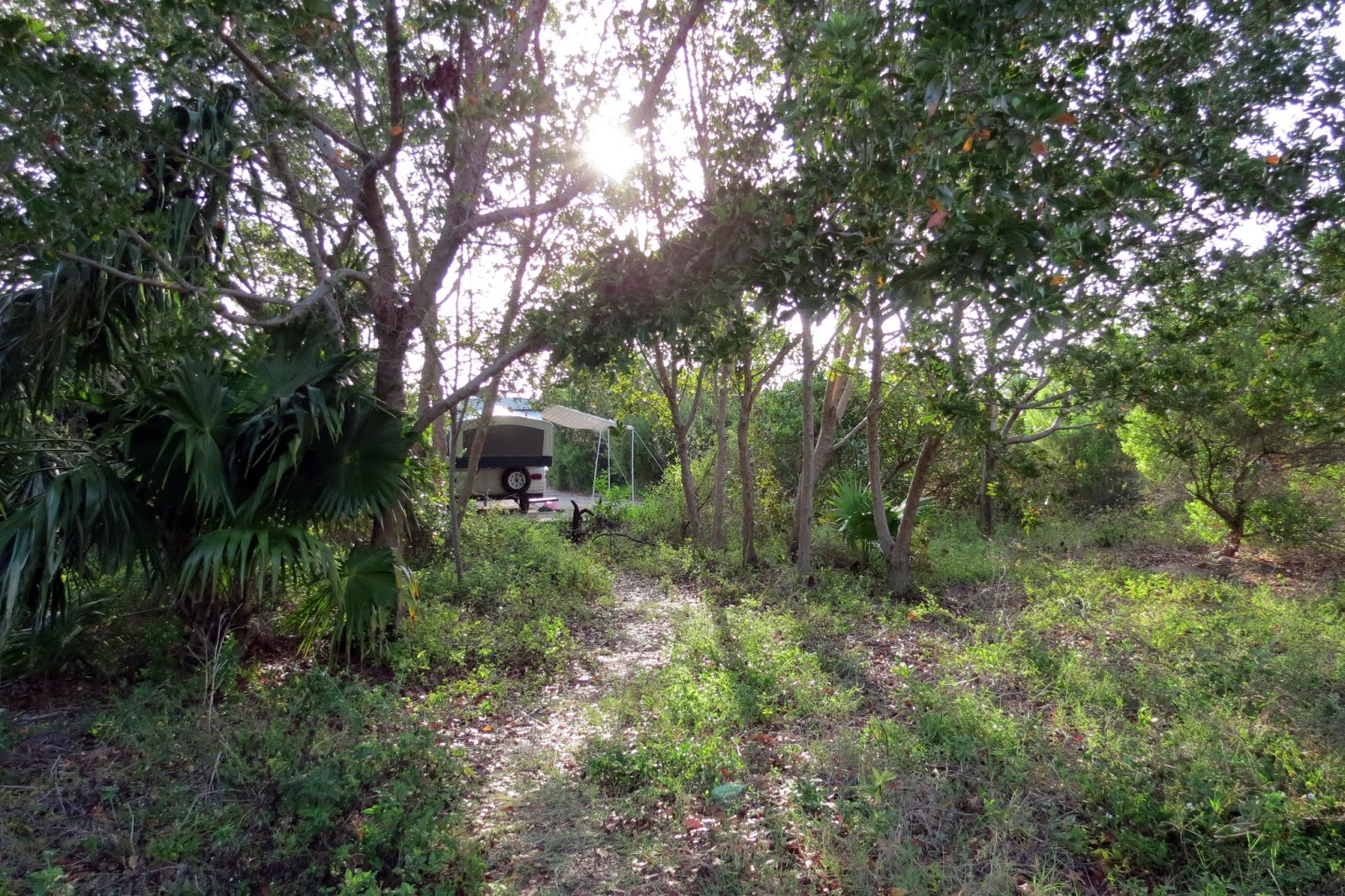
The view from behind our campsite at Curry Hammock State Park

On our way home, we stopped at the Port Orange Causeway Park. Here we got to watch an American Oystercatcher with babies feeding on a Horseshoe Crab. We also got this family photo. Much thanks to Matt and Kelsey for inviting us along on their roadtrip!


Below is a complete list of critters that we were able to identify!

Birds (*Life Birds)
*Mottled Duck
Blue-winged Teal
Lesser Scaup
Wild Turkey
Wood Stork
Magnificent Frigatebird
Double-crested Cormorant
Anhinga
American White Pelican
Brown Pelican
Great Blue Heron
Great White Heron (White morph of GBHE)
Yellow-crowned Night-Heron
Great Egret
Snowy Egret
Little Blue Heron
Tricolored Heron
Reddish Egret
Cattle Egret
Yellow-crowned Night-Heron
White Ibis
Glossy Ibis
Black Vulture
Turkey Vulture
Osprey
Swallow-tailed Kite
Bald Eagle
Red-shouldered Hawk
Purple Gallinule
Common Gallinule
Limpkin
Sandhill Crane
Black-necked Stilt
*American Oystercatcher
Black-bellied Plover
Semipalmated Plover
Killdeer
Spotted Sandpiper
Willet
Ruddy Turnstone
Sanderling
Dunlin
Least Sandpiper
Western Sandpiper
Short-billed Dowitcher
Bonaparte's Gull
Laughing Gull
Herring Gull
*Least Tern
Caspian Tern
Royal Tenr
Black Skimmer
Rock Pigeon
*White-crowned Pigeon
Eurasian Collared-Dove
*Common Ground-Dove
Mourning Dove
Yellow-billed Cuckoo
Barred Owl
Common Nighthawk
*Chuck-will's-widow
Chimney Swift
Belted Kingfisher
Red-bellied Woodpecker
Northern Flicker
Pileated Woodpecker
*Monk Parakeet
Great Crested Flycatcher
Eastern Kingbird
*Gray Kingbird
Loggerhead Shrike
White-eyed Vireo
*Black-whiskered Vireo
Blue Jay
American Crow
*Fish Crow
Northern Rough-winged Swallow
Purple Martin
Bank Swallow
Barn Swallow
Tufted Titmouse
Carolina Wren
Blue-gray Gnatcatcher
Gray-cheeked Thrush
American Robin
Gray Catbird
Northern Mockingbird
*Common Myna
European Starling
Ovenbird
Worm-eating Warbler
Northern Waterthrush
Black-and-white Warbler
Common Yellowthroat
American Redstart
Cape May Warbler
Northern Parula
Blackpoll Warbler
Black-throated Blue Warbler
Palm Warbler
Yellow-rumped Warbler
*Prairie Warbler
Chipping Sparrow
Summer Tanager
Northern Cardinal
Blue Grosbeak
Indigo Bunting
Red-winged Blackbird
Eastern Meadowlark
Common Grackle
*Boat-tailed Grackle
Brown-headed Cowbird
House Sparrow

Reptiles/Amphibians
Yellow Rat Snake
Southern Ringneck Snake
Oak Toad
Cuban Tree Frog
Fowler's Toad
Narrow-mouthed Frog
Florida Cricket Frog
Cuban Treefrog
Green Treefrog
Squirrel Treefrog
Pinewoods Treefrog
Cuban Brown Anole
Curly-tailed Lizard
Green Iguana
Six-lined Racerunner
Mediterranean Gecko
Southeastern Five-lined Skink
Broad-headed Skink
Gopher Tortoise

Fish/Mollusks/Crustaceans
Spotted Eagle Ray
Blue Land Crab
Bermuda Chub
Sergeant Major
Blue Parrotfish
Atlantic Needlefish
Cassiopea Jellyfish (Upside-down Jellyfish)
Conch
Atlantic Blue Crab
Blue Land Crab
Caribbean Hermit Crab
Marine Hermit Crab
Barnacles

Mammals
Manatee
Nine-banded Armadillo
Key Deer (endangered subspecies of White-tailed Deer)
White-tailed Deer

Thursday, 9 March 2017

Santa Ana National Wildlife Refuge

November 3, 2016

Santa Ana is a beautiful wildlife refuge along the Rio Grande River in South Texas. While we were in the area, a Northern Jacana had been reported at Santa Ana so we agreed the bird would be a nice addition to our ABA lists and we headed out to look for it! We had a bit of driving ahead of us so we didn't arrive until 11:30am and it was already HOT! We hiked along a forested trail until we reached the first pond where the Jacana had been seen. We had already started adding up some life birds! (Black-crested Titmouse and Long-billed Thrasher)


The first pond was deeper than it had been recently so the Jacana was nowhere in sight. Other birders who had been searching the park since it opened that morning reported that the bird hadn't been seen all day. Either way, we had fun birding the area. Great Kiskadees called from every direction! The pond was full of waterfowl and shorebirds including Least Grebes, which were at the top of my list of birds I hoped to see in Texas! Other birds here were Black-necked Stilts, Stilt Sandpipers, and a White-faced Ibis. As we scanned the water, I noticed a dark snake swimming in the water. My first instinct was that it was a Texas Indigo Snake, but I didn't know if they were swimmers, so I asked Ben what it was. He confirmed it and was very excited because it was on his most wanted list! A few minutes later, another lifer snake swam by... a slender Western Ribbon Snake!

We continued to hike and stopped by a duck blind to get a different angle on the pond, in hopes of spotting the hiding Jacana. As we entered the blind, Ben spotted a Black Witch sleeping on the support beams. Black Witches are moths with a ~7" wingspan and bat-like flight. Their common name comes from a variety of folklore and superstitions from Southern Texas, to Mexico, Jamaica, and other areas of the Caribbean. Some say you've had an evil spell cast on you if you see one, others say if someone is sick and one flies into their home, they will die. I felt we were quite lucky to get to see one... but maybe there was a spell cast upon us because we missed the Northern Jacana and an assortment of other target birds for our trip! As we were leaving the blind, we ran into a friend. While we chatted and wandered along the path, he mentioned that he had never been the one to first spot a Common Pauraque so he wanted to try. Just moments later, he actually spotted one!


This was the first time I'd seen a Common Pauraque so close, and during the day! In Guatemala, I saw quite a few along the roads as we drove around at night, but it was amazing to see the feather detail in the daylight! After more hiking in the forested area, we trekked into more open and sunny territories. We both had water with us and wore hats and sunscreen so we didn't worry too much about the long hike. As we got into some brushy habitat, Ben noticed an Olive Sparrow! Another of the sneaky birds we had hoped to see. A lifer for both of us!! We continued on until we reached the next set of ponds, hoping to respot the Jacana. No luck, but we did see Roseate Spoonbills, and a variety of shorebirds!

Tuesday, 31 May 2016

Ohio Big Day

At 1:00 AM, May 17, 2016, our alarms sounded. Our team, the Benannaquits, sleepily, yet excitedly, dressed and headed to the already packed car. Ben, my mother, Julie and I were off on our Big Day birdathon for the Columbus Audubon! By 1:52, we had our first species of the day: the night flight call of a Swainson's Thrush. Decided to start our day north. We drove first to Oak Openings Preserve Metropark, usually one of my favorite birding locations. The weather wasn't great and in the mist of the night, a single close Grasshopper Sparrow sang, and in the distance, another replied. We listened carefully to pick out even the quietest of calls from any other species, and besides crickets, the night was silent. We still had a few hours before sunrise so we opted to go to Irwin Prairie and return to Oak Openings later, for a hopefully better start. As we arrived at Irwin Prairie, the birds started to awaken. American Woodcocks "peented" before the first Field Sparrow began singing. A distant rooster seemed to wake the Song Sparrows, American Robins, Common Yellowthroats, and Swamp Sparrows. After tallying 16 more species before 6AM, we went back to Oak Openings, hoping for the specialty birds there. The second attempt was more what we were hoping for! Orchard and Baltimore Orioles, Scarlet and Summer Tanagers, Acadian and Willow Flycatchers, Red-headed Woodpeckers, Lark Sparrows, Blue-winged Warblers and more. We were finally off to a decent start!

Oak Openings. A reliable area for Lark Sparrow, Red-headed Woodpeckers, and Summer Tanager. 

Our next stop was for some shorebirds. We knew the Curlew Sandpiper we saw last week was gone, but the habitat was still good so we wanted to check the location. We successfully tallied 9 species of shorebirds, American Pipit and all the expected swallows. The most exciting bird for me, was one of several White-rumped Sandpipers! The first I have ever seen during spring migration! White-rumped Sandpiper was a bit of a nemesis for me, until I finally got it, then I seemed to see them every time I went birding last fall.

White-rumped Sandpiper. Phone-scoped photo by Ben Warner.

As I walked along the dike, hoping to stumble upon the Least Bittern that was hanging out during The Biggest Week, I almost literally stumbled upon a Purple Martin. I looked down, and there it was, 3 inches from my boot. I reached down slowly to pick it up, and the poor bird didn't even have the energy to try to get away. I gently picked him up, as I had been trained to during avian rehab and bird banding internships. I quickly walked back to my mom and Ben who were still scanning the mudflats for shorebirds. I said "I have a Purple Martin!" and they replied, "you HAVE one?" I held it up and explained how I found it. I peeked in the scope to see the last few shorebirds so we could add them to our list and I looked p the phone number for a nearby wildlife rehab facility. Of course they were still closed, it wasn't even 9AM yet. I contacted several friends in NE Ohio to see if they could help or had ideas of another place we could take the bird. Kimberly Kaufman almost immediately responded saying that she would care for the martin if we could bring it over to BSBO. BSBO/Magee Marsh wasn't scheduled until later in the day but we reversed our plans to get the bird to her asap! Of course it was great to take a minute to see my Bird-mom and get a hug before we rushed back to our Big Day!

Up next was the Magee Marsh causeway, boardwalk and beach. The birds weren't overly numerous, as they often are, but we slowed our pace to get spectacular views of warblers, such as this Northern Parula that was waist-level, literally 3ft from us! Ben took this photo with his PHONE! No adapters.
Northern Parula. Magee Marsh Boardwalk. Photo by Ben Warner.
We also got great looks at Philadelphia Vireos, Blackburnian Warblers, Canada Warblers, Black-throated Blue Warblers, and a lovely perched Ruby-throated Hummingbird! After we walked the boardwalk, we headed towards the beach to scan for terns and shorebirds. On our way, a small group had gathered where some had been seeing a Connecticut Warbler. We scanned the beach with little success and then returned to the CONW spot. By then, several others had joined in, including a group from Cleveland led by Jen Brumfield. Jen pretty quickly refound the bird and got nearly everyone on it! I was able to see it for a few seconds as it walked along foraging! Thanks Jen! That was only the second Connecticut Warbler I've seen, and the first, 2 years ago, was only about 20 meters away from this one!

Jen also gave us a tip of some Wilson's Phalaropes being seen at the Benton-Carroll Rd Boss Unit, which was already our next stop anyway. In addition to the Wilson's Phalarope, we added several birds to our day list: Green-winged Teal, Short-billed Dowitcher, Greater Yellowlegs and a Red-tailed Hawk.

We continued west along the lake to Metzger Marsh. By now, it was nearly 3:30pm. As we drove along the causeway, a small brown bird darted next to the road into a pile of logs and branches. I quick glimpse of the bird indicated a new species for the day: Lincoln's Sparrow! As we watched for a closer look, several Marsh Wrens sang away in the marsh! Another new bird! We arrived at the parking lot and decided to walk along the lake to scan for gulls and terns. As we walked, we saw some birds moving in a tall tree. Two Nashville Warblers foraged in the foliage. Another new bird for the day! It was interesting how a so abundant in the days and weeks prior seemed to be totally gone from the area with the change in weather, but thankfully at least these two were still around! Common and Caspian Terns were added and we were off to Maumee Bay State Park.

One of our main targets at MBSP were the Eastern Screech Owls that nest in boxes along the boardwalk. Unfortunately, the cooler weather must have had the babies huddled together inside and no one was peeking out of either box. There were no signs of fledged babies or parents hanging around in the trees nearby either. Oh well, we didn't have time to spend searching, so we continued along. We made it to the marsh at the end of the cabin camping area. One of the first birds we heard was an American Bittern! Shortly after, we spotted a Common Gallinule. Two new species! After spending some time waiting for a Mourning Warbler to pop out from behind a log with several other birders that had seen it a while before or had also not yet seen it, we decided we should probably keep moving without it. A stop at the beach yielded one additional new bird for the year... a single Ruddy Turnstone. At just after 6pm, standing at 135 for the day, we knew we had a long drive to our final destination before dark and we weren't sure we would reach our goal of 140.

We arrived at Killdeer Plains Wildlife Area at 7:51pm. Our first stop wasn't promising. There were no waterfowl on the water, but as we headed back to the car, we heard a Sandhill Crane calling! We finally found some waterfowl and added Mute Swan, American Wigeon, Hooded Merganser, and Ruddy Duck. As we were birding we heard a Ring-necked Pheasant calling from a field! We've seen pheasants at KPWA before, but it definitely wasn't a bird I was expecting that evening so it was a very pleasant surprise! As we drove to look for shorebirds, we were commenting about seeing TONS of Gray Catbirds all day, several Brown Thrashers, but not a single mockingbird. After another catbird flew across the road, we joked about just counting it as a mockingbird. Just then, I saw something in a tree and told Ben, who was driving at the time, to stop a reverse a bit. There in a tree, 8 feet off the ground and right along the roadside was our Northern Mockingbird for the day! We all cheered and went along on our search for more shorebirds or waterfowl. We pulled up to an area that is often good for shorebirds, but there wasn't much out there. A few Killdeer and yellowlegs walked through the shallow water. Then Ben found them, probably the best birds of the day, and definitely the least expected birds of the day: a pair of Black-necked Stilts! We figured these would be the last birds of the daylight, and we had already surpassed our goal, so we all enjoyed these birds. We watched them through our binoculars and took turns looking through the scopes at these two tall, beautiful birds. Ben and I were even able to get a few shots with our phones, handheld through the scope. Here's Ben's:

Black-necked Stilts at KPWA
Our last efforts to see waterfowl before dark were at the reservoir. As we scanned across the water with our scopes, I saw a duck quickly move behind an island. I couldn't immediately tell what it was in the low light and with such a brief view, but I thought it was a scaup. This was good because we didn't have either scaup for the day so either way it was an additional species! Ben confirmed that it was a Greater Scaup, which isn't typical for this time of year. After we watched it to get an ID, Ben was able to get this photo of our last bird of the day.

Greater Scaup in the last light of the day. KPWA.
It was a fun day to spend together and out birding, but it was for a cause. Our day was to support the Columbus Audubon's efforts of educating the public, supporting local conservation, and funding the Ohio Young Birders, a great group that gets kids out birding and learning about the environment! Please consider supporting Columbus Audubon and our team, the Benannaquits, by following this link to donate: Donate Here!

Thank you for reading about our day and donating! 
My mom and me birding during our Big Day! 

Here's a complete list of our 144 species:
  1. Canada Goose
  2. Mute Swan
  3. Trumpeter Swan
  4. Wood Duck
  5. American Wigeon
  6. Mallard
  7. Blue-winged Teal
  8. Green-winged Teal
  9. Greater Scaup
  10. Hooded Merganser
  11. Ruddy Duck
  12. Ring-necked Pheasant 
  13. Pied-billed Grebe
  14. Double-crested Cormorant
  15. American Bittern
  16. Great Blue Heron
  17. Great Egret
  18. Snowy Egret
  19. Green Heron
  20. Turkey Vulture
  21. Bald Eagle
  22. Red-tailed Hawk
  23. Sora
  24. Common Gallinule
  25. American Coot
  26. Sandhill Crane
  27. Black-necked Stilt
  28. Semipalmated Plover
  29. Killdeer
  30. Spotted Sandpiper
  31. Solitary Sandpiper
  32. Greater Yellowlegs
  33. Lesser Yellowlegs
  34. Ruddy Turnstone
  35. Dunlin
  36. Least Sandpiper
  37. White-rumped Sandpiper
  38. Semipalmated Sandpiper
  39. Short-billed Dowitcher
  40. American Woodcock
  41. Wilson's Phalarope
  42. Ring-billed Gull
  43. Herring Gull
  44. Caspian Tern
  45. Common Tern
  46. Rock Pigeon
  47. Mourning Dove
  48. Common Nighthawk
  49. Chimney Swift
  50. Ruby-throated Hummingbird
  51. Red-headed Woodpecker
  52. Red-bellied Woodpecker
  53. Downy Woodpecker
  54. Hairy Woodpecker
  55. Yellow-shafted Flicker
  56. American Kestrel
  57. Eastern Wood-Pewee
  58. Acadian Flycatcher
  59. Willow Flycatcher
  60. Least Flycatcher
  61. Eastern Phoebe
  62. Great Crested Flycatcher
  63. Eastern Kingbird
  64. White-eyed Vireo
  65. Yellow-throated Vireo
  66. Blue-headed Vireo
  67. Warbling Vireo
  68. Philadelphia Vireo
  69. Red-eyed Vireo
  70. Blue Jay
  71. American Crow
  72. Horned Lark
  73. Northern Rough-winged Swallow
  74. Purple Martin
  75. Tree Swallow
  76. Bank Swallow
  77. Barn Swallow
  78. Cliff Swallow
  79. Black-capped Chickadee
  80. Tufted Titmouse
  81. White-breasted Nuthatch
  82. House Wren
  83. Marsh Wren
  84. Blue-gray Gnatcatcher
  85. Ruby-crowned Kinglet
  86. Eastern Bluebird 
  87. Veery
  88. Gray-cheeked Thrush
  89. Swainson's Thrush
  90. Wood Thrush
  91. American Robin
  92. Gray Catbird
  93. Brown Thrasher
  94. Northern Mockingbird
  95. European Starling
  96. American Pipit
  97. Ovenbird
  98. Northern Waterthrush
  99. Blue-winged Warbler
  100. Black-and-white Warbler
  101. Prothonotary Warbler
  102. Tennessee Warbler
  103. Nashville Warbler
  104. Connecticut Warbler
  105. Common Yellowthroat
  106. American Redstart
  107. Cape May Warbler
  108. Northern Parula
  109. Magnolia Warbler
  110. Bay-breasted Warbler
  111. Blackburnian Warbler
  112. Yellow Warbler
  113. Chestnut-sided Warbler
  114. Blackpoll Warbler
  115. Black-throated Blue Warbler
  116. Palm Warbler
  117. Myrtle Warbler
  118. Black-throated Green Warbler
  119. Canada Warbler
  120. Wilson's Warbler
  121. Grasshopper Sparrow
  122. Chipping Sparrow
  123. Field Sparrow 
  124. Lark Sparrow
  125. White-crowned Sparrow
  126. White-throated Sparrow 
  127. Savannah Sparrow
  128. Song Sparrow
  129. Lincoln's Sparrow
  130. Swamp Sparrow
  131. Eastern Towhee
  132. Summer Tanager
  133. Scarlet Tanager
  134. Northern Cardinal
  135. Rose-breasted Grosbeak
  136. Indigo Bunting
  137. Red-winged Blackbird
  138. Eastern Meadowlark
  139. Common Grackle
  140. Brown-headed Cowbird
  141. Orchard Oriole
  142. Baltimore Oriole
  143. American Goldfinch
  144. House Sparrow

Monday, 1 July 2013

Alaska at Last!

I AM IN ALASKA!!!

I am currently sitting outside at the Sourdough Campground in Tok, Alaska, enjoying a Gray Jay in the tree next to me! I think he wants a snack, but unfortunately, I have nothing with me. I did enjoy Caribou chili in a homemade sourdough bread bowl for dinner! Here's a picture of a Gray Jay that I saw this morning...


We arrived in Alaska yesterday afternoon and stayed at a campground in the Tetlin National Wildlife Refuge. There weren't many birds around but we learned that there was a very late (major) snow storm in mid-May that occurred once many of the birds had arrived or while they were still arriving. It likely killed a lot of passerines and waterfowl that were coming in had no place to land because all of the lakes were still totally frozen. Surveys that will occur later this summer will be able to show the real damage from the storm.

In addition, when we arrived in Alaska, we were informed that there were fires in the area. Climate change has been causing increased fires in Alaska. Hotter and drier conditions make lightening storms deadly. There are currently 90 fires burning in Alaska. Thankfully, we haven't come across any yet, but we did see smoke settling in a valley where a fire had been burning.

In the hotter weather yesterday, I swam in Deadman Lake! The water was super clear and it didn't seem at all like I was swimming in a lake. Here's a picture of the lake:


Monday, 17 June 2013

How do you catch a unique bird?

Unique up on it!!

Okay, so that joke isn't that funny... but we did discover quite a few unique birds this morning in North Dakota and then hit the road and found more interesting birds in Montana! Some of our best sightings in ND this morning, however, were NOT birds!! I spotted a moose at Lostwood National Wildlife Refuge and we saw Richardson's Ground Squirrels and Thirteen-lined Ground Squirrels! The moose was quite incredible and Lostwood also produced three more life birds for me: Willet, Baird's Sparrow, and Piping Plover.


Within two hours of crossing the border into Montana, I already had FOUR life birds!!! Chestnut-collared Longspurs and Lark Buntings were displaying in a field along the driveway of Medicine Lake National Wildlife Refuge. California Gulls breed there and I saw well over 100 of them along with American White Pelicans and plenty of Western Grebes! My fourth life bird was along US Route 2 and we turned around to see it! I never realized Black-billed Magpies were so big and had such a long tail! I didn't get a great look before/while it flew, but I was still amazed!!

As we were driving through Montana, I noticed that Cookie was lying in Chip's spot (Cookie and Chip are Margaret's dogs that are along on the trip!) I looked back to see where Chip was and it seemed that he was gone! We searched around and no Chip anywhere... I finally looked under the table that was folded down and there he was! It was pretty funny!!

In all it was a pretty great day!! I left North Dakota with 102 species of birds and a nice list of mammals as well! Margaret is up to 417 species for the year, and although I am not actively keeping a year list, my life list is continually growing with 29 new birds added since the start of the trip!!

Sunday, 16 June 2013

I love North Dakota!!

Last night we stayed at a campground without wifi, but it was a great day! Margaret and I birded one of the most beautiful areas I have ever seen: Arrowwood National Wildlife Refuge. Besides the birds, we saw part of a bison herd that included the BIGGEST bull bison either of us have ever seen, some cows, and a bouncy little calf! It was a little bit terrifying being on the same side of the fence with this massive animal!
Today we birded around the Carrington, ND area and near Chase Lake, although we never actually made it to the lake due to the "low management" roads that were pretty much impassable for the RV! I saw TONS of new birds the past two days. I never imagined North Dakota as such an amazing state for birding, but it has been incredible and we still have another stop in North Dakota tomorrow!!

Margaret is working towards her goal of 450 species this year and is well on her way to meeting that goal with 415 as of today!!

So far, North Dakota has given me 92 species including SIXTEEN Life Birds!!

Western Grebe
Western Kingbird
Vesper Sparrow
Eared Grebe
Le Conte's Sparrow
Western Meadowlark
Ferruginous Hawk
Eurasian Collared-Dove
Gray Partridge
American Bittern
Swainson's Hawk
American Avocet
Black Tern
Grasshopper Sparrow
Nelson's Sparrow
Cattle Egret

My Grasshopper Sparrow Life Bird!!


Check out more of my photos from the trip here: 

Friday, 14 June 2013

FIVE Life Birds in Minnesota!

Today was an amazingly awesome day!!! We spent all day in Minnesota and visited a National Wildlife Refuge called Prairie Wetlands Learning Center. I highly highly recommend visiting the park if you are ever in   the Fergus Falls, Minnesota area. The area is beautiful and even in the middle part of the day, the birds are great!! I got FOUR new Life Birds at the refuge and one more along the interstate today!

My first life bird was American White Pelican... a nemesis bird of mine back in Ohio! At Prairie Wetlands, I picked up Clay-colored Sparrows, Yellow-headed Blackbirds (which I think are now my favorite bird!), Brewer's Blackbird, and a Sedge Wren!

I took tons of pictures today... Here are a few!
Bobolink in Minnesota

My Life Clay-colored Sparrows!

The Prairie Wetlands Learning Center


Me right before I saw my lifer Yellow-headed Blackbirds!!

My new favorite bird: Yellow-headed Blackbird!


Margaret watching sparrows!

Thirteen-lined Ground Squirrel