Showing posts with label Ohio. Show all posts

Tuesday, 9 October 2018

It feels good to save a life...

Some days are better than others.

While this phrase holds true with most things in life, it is definitely true for herping. Looking for reptiles can have some pretty extreme highs and lows. Today, Ben and I went out to road cruise for snakes. If you aren't familiar with road cruising, it consists of carefully driving roads in good habitat, looking for reptiles that may be crossing the road. Often this is done at night, but in the fall in Ohio, snakes like to come out onto the roads as they warm up after a cool night. This opens up all the opportunities for them to be killed by vehicles, both accidentally, and intentionally. So we road cruise in the fall, not only to see some really cool critters, but to hopefully save the lives of some of them that may not otherwise have a chance.


Today was rough. Although we found an astonishing 77 snakes total in about 4.5 hours, we only had a 55% success rate. Today we found LOTS of dead snakes. The area we selected is home to 3 species of endangered snakes. Often, we don't see any of the three, but today, we found 5 endangered Kirtland's Snakes (Clonophis kirtlandii) and unfortunately all 5 were dead. Some were flattened and had been there for a while, but several may have been saved if we had gone yesterday too. We found 16 Eastern Garter Snakes... dead. 10 Dekay's Brown Snakes... dead. Red-bellied Snake? Dead. Northern Water Snakes... yep, also dead. Perhaps, the most crushing moment of the day was towards the end of the afternoon, when I was already feeling tired and ready to go home as we cruised one final road. I pulled a live Dekay's off the road on my side of the car while Ben mentioned that I might not want to see what was on his side. I went to see what he found, and he was right. I did not want to see my lifer Smooth Green Snake (Opheodrys vernalis) with fresh fatal wounds. Perhaps if we had cruised that stretch of road even an hour prior I might have ended the day with a huge victory rather than immediate sadness.

A Kirtland's Snake (Clonophis kirtlandii) that I found in 2014.

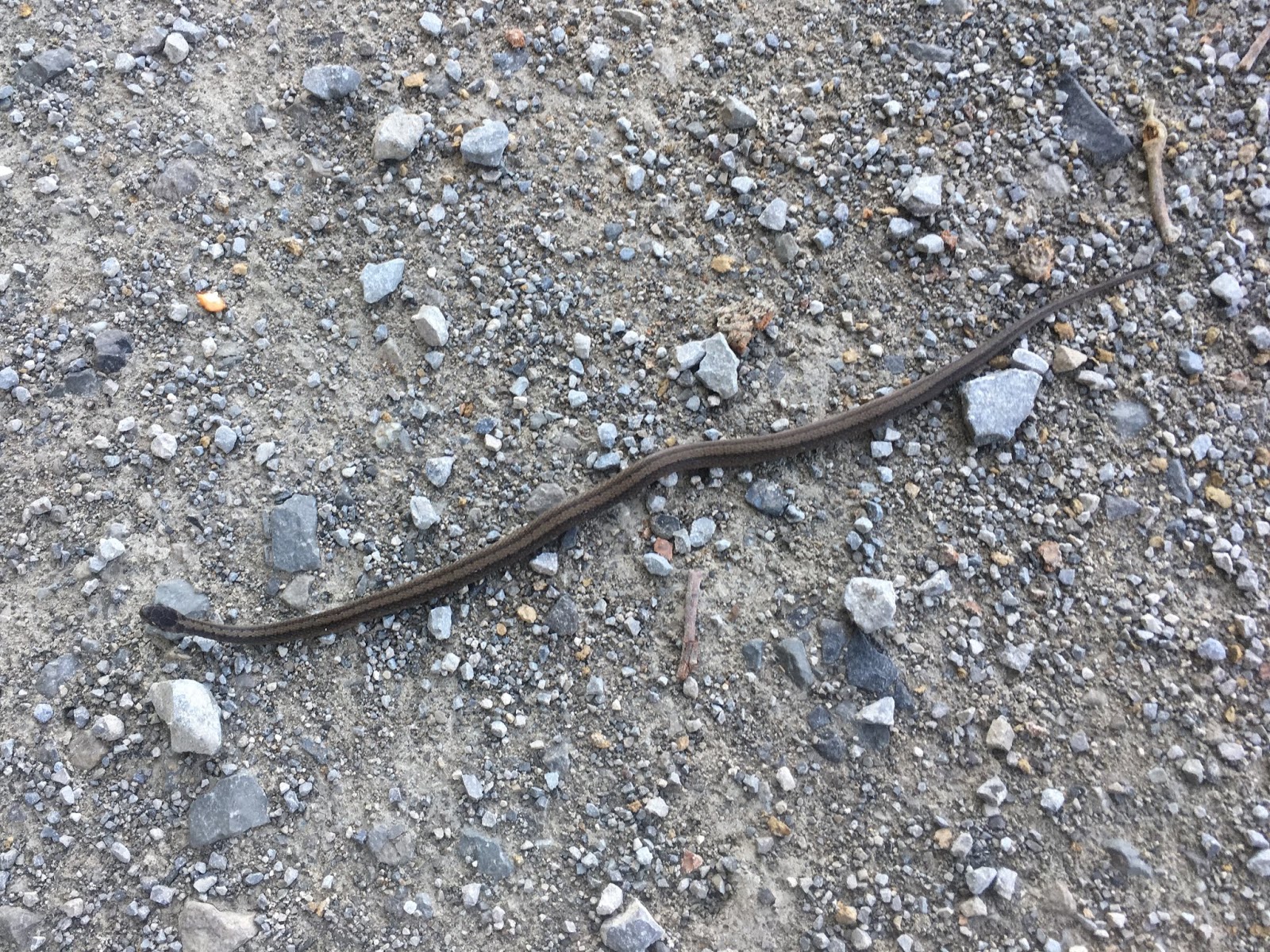
Sometimes it is difficult for me to see past the dead snakes and enjoy the day, but I try hard to see the bright side. A 55% success rate means that 42 of the snakes we found were saved from the road! Although the lows were extremely low with endangered species and life snakes, if felt great to see so many live snakes slithering into the grass OFF the road! As we cruised along slowly on gravel roads, we would stop for any snake and many sticks that looked a bit snake-like. In some areas, I would get out and walk along the road while Ben followed in my Prius. One of my best finds while I was walking was this very young Red-bellied Snake (Storeria occipitomaculata)... one of my favorites!

Red-bellied Snake 

Red-bellied Snake


Diversity of the living snakes was low, but individual counts were high! We found 19 Dekay's Brown Snakes (Storeria dekayi) ranging from 5-13" long. Here are a few of the cute little snakes:

Dekay's Brown Snake


We also encouraged 21 Eastern Garter Snakes (Thamnophis sirtalis) from the road. Immediately after my defeat in seeing the Green Snake, I spotted a live snake in the road. We stopped and I jumped out, exclaiming that it looked dark. Once I got close enough to see, it was all black! Melanistic Garter Snakes aren't common, and especially not in this region of Ohio. This little one was especially beautiful and unique since it had a pink chin. Melanism is essentially the opposite of albino. Melanistic animals have an excess of the dark pigment, Melanin. Moving this gorgeous animal far from the road was definitely a highlight of the day.

Eastern Garter Snakes vary a lot in color and pattern. Check out a few of today's finds!

Melanistic Eastern Garter Snake

Melanistic Eastern Garter Snake


Eastern Garter Snake


In all it was a good day to be out helping the wildlife!

Tuesday, 12 June 2018

Overcoming a Cavernous Fear

"Today I went into a cave."

That is a sentence I never imagined being able to say again.

As a young child, I loved caves. With my family and girl scout troop, I visited caves all over Ohio and Kentucky. When I was 10 years old, a family friend was visiting from out of state and we took him to Olentangy Caverns, here in Central Ohio. I won't go into too much detail, but towards the end of our visit, the lights went off in the cave. My family, our friend, and I were trapped in the cave; locked in with the lights off. There was no warning over the intercom that they were closing; no inspection by employees to make sure all guests were out. They closed up and went home. Finally, as the gift shop attendant was heading home she saw our vehicle in the lot. She searched the other attractions, before finally checking the cave.

Needless to say, I hated caves after that. Just the talk of a cave, or a photo, or a sign for a cave would make my heart race. 15 years after the incident, I was in Guatemala. The farm where I was staying had a cave on the property with a colony of White-collared Swifts. With a natural opening, and a lot of motivation to see the swifts, I decided to brave the cave. The swifts were spectacular but the experience was not good. The person leading me through the cave decided she wanted me to see the underground river, although I wasn't interested. I was hopping over rocks with gaps between and I had no idea how deep they went. I didn't have a flashlight and it was dark. I slipped and fell at one point, and nearly threw up by the time I got out. My knees were giving out, and I could hardly make it back to the cabin. I vowed that I would try a cave again in another 15 years. Maybe.

My friend Ruth standing in a natural beam
of light in the cave 

I had Ruth take my picture, knowing my family
wouldn't believe I went into a cave.

Fast forward 19 years from the originial incident to today... Ben and I were planning to visit Cedar Bog in Urbana, Ohio when we started driving through some rain. Since we were already nearly halfway there, I did a quick google search to find something to do in the area besides hiking all day in the rain. "Ohio Caverns" popped up on the list under Cedar Bog, a canoe livery, a berry farm that wasn't open, and.... the "World's Largest Loaf of Bread." At first I was joking. I said, "we could go visit a cave." But when I said it, I didn't immediately feel my chest tighten. My heart didn't start racing and my palms didn't get sweaty. I decided that I was willing to give it a try, but it had to be now. I didn't want to plan to come back another day and have days or weeks to talk myself out of it.

The weather cleared up so we hiked at Cedar Bog. I didn't think about the cave any over the next few hours while I enjoyed the beautiful scenery and wildlife. Afterwards, Ben mentioned the cave again, and I said, "okay." This time I did start to feel anxious. I didn't want to talk about it before hand, I just wanted to book the soonest tour and get it over with. We met in front of a water tower for the 2:15 tour. It was 2:13 when the guides arrived and it seemed like hours before 2:15 finally came. We started the tour by walking down a long winding ramp to the entrance. Ben was asking if I was okay... asking if we should tell the guide about my fear... asking if I wanted to be in the front or back of the group... asking if I wanted to hold his hand. I could barely hear or focus on the questions with ringing ears. I didn't want to talk about it or think about it. I just wanted to get inside and get it over with.

We arrived at the door. It was a locked metal door with a key pad to get in. At that moment I knew if I went inside, I would have to finish the tour. I wouldn't be able to just turn around and leave. Tears filled my eyes and I swallowed hard. I wanted to turn around and run, but I looked back at the kid behind me who had just said he had never been in a cave before. I remembered how much I loved caves at that age. I didn't want to cause a scene and ruin his experience, so I kept going.

I went inside.

We walked about 50 feet in before the guide stopped us to start talking about the cave system. I was already crying but trying to take deep breaths and convince myself that I was going to be okay. It was going to be fine. I couldn't hear much of what the guide was saying even though she was immediately next to me. And then I heard the words. "Now I'll show you what it's like without the lights." She explained that it would be dark and your eyes wouldn't be able to adjust to the darkness. I had heard these exact words before, over 20 years ago on previous tours in other caves. I remembered these words 19 years ago when we were trapped in the cave. And now I was hearing them again. I tried hard to keep breathing. She flipped the switch and the lights went out. I took a breath and thought everything would be alright... and then I was sobbing. I couldn't do this. I heard the guide quickly say she didn't like the dark and the lights came back on. I wanted to ask to leave but I couldn't speak. I also realized I had survived that second and a half and I wanted to keep going.


For the next 20 minutes or so, I walked through the cave. I was still crying at times but feeling less and less anxious. Every corner we turned was another amazingly beautiful natural feature of the cave. Before long, I wasn't feeling anxious at all! I was taking photos with my phone and actually enjoying my surroundings. By the time the hour-long tour ended, it hadn't seemed like an hour at all!


As we exited the cave, I was climbing the stairs to exit and it hit me again. I vividly remembered holding my sister's hand as we ran up the stairs together exiting the cave 19 years ago after the lights finally came back on, and the gift shop attendant led us to the door. I quickened my pace and climbed the 60 stairs today to get out of the stairwell. I reached the top out of breath and my legs were feeling it. But I did it! I went in the cave. I enjoyed the cave. I survived. And guess what? I might go into a cave again. It's not my favorite thing anymore; I won't be planning trips around visiting special caves, but at least I know I can do it.


After thinking about it all evening, I decided to share my fear and share my story with my friends. I hope that it can help even one person decide to take a step towards conquering their anxiety or fear. Not immediately, but when the time is right. For me, for some unknown reason, my time was today. It took me nearly 20 years to be ready to face my fear again and force my anxiety away long enough to make it through that doorway. But even after getting through the cave, reliving 19 years ago and even reliving my expeirence today had me crying the entire time I was typing this post. It'll be a long road, but I am proud to say, "today I went in a cave."

Please enjoy some of the beautiful features of the Ohio Caverns that I visited today.


Monday, 28 May 2018

2018 Birdathon Big Day

Monday, May 14, 2018

The BenAnnaquits set off for our 3rd year of participation in the Columbus Audubon Birdathon! This year's Birdathon was extra exciting because we were testing out a new route. Our goal was to beat last year's total of 153 species. We started off at 11:00 PM Sunday night to head towards our starting destination in Southern Ohio. An hour later, our timer started and we rolled down the car windows, anxiously awaiting our first bird of the day. Gray Catbird! We continued towards Tranquility Wildlife Area, making several stops along grassy fields listening over the sounds of Cope's Gray Treefrogs and Blanchard's Cricket Frogs. We added Yellow-breasted Chat, Northern Mockingbird, and Henslow's Sparrow before arriving at our starting destination. As we quietly crept down the roads of the wildlife area, our main target began to call... a Chuck-will's-widow! Chuck-wills-widow was even a new state bird for me! (#331 for Ohio) Several Eastern Whip-poor-wills called all around us as we listen for a distant Barred Owl.

Clear Creek Metro Park. Photo by Anna Wittmer

We arrived at Clear Creek Metro Park before the dawn chorus started. An Eastern Whip-poor-will called into the silence of the night. As the birds woke up, we began our hike. A chorus of Wood Thrushes sang through the mist of the morning. Cerulean Warblers and Black-throated Green Warblers buzzed in the tree tops. Before long, we heard a Worm-eating Warbler, not far from the trail. It didn't take long before our team all got to see him as he sang repeatedly! Driving from one end of Clear Creek Metro Park to the other, we saw a beautiful Luna Moth flutter in front of us. Shortly after, Ben spotted a Milk Snake in the road. This has been a nemesis herp of mine for years! I jumped out to see it and help it across the road. I was thrilled to have this gorgeous guy in my hands for the first time!

Me with my lifer Milk Snake! Photo by Julie Wittmer

Milk Snake bellies. Photo by Julie Wittmer

Just seconds down the road, an Eastern Box Turtle crossed. Again I hopped out of the car to assist her crossing. We added several more species, including Yellow-billed Cuckoo, Pileated Woodpecker, Indigo Bunting, and Ruby-throated Hummingbird before continuing our journey north. Along the route, we added Turkey Vultures and Rock Pigeons.

Eastern Box Turtle crossing the road. Photo by Anna Wittmer

Upon arriving at Pickerington Ponds Metro Park at 9:20am, it was alreay getting rather warm. We quickly scoped a Barn Owl nesting site before tallying a White-eyed Vireo in the parking lot!

Our next stop was Bolton Field Airport. We found a patch of shade to scope the grasslands as we heard several Eastern Meadowlarks call. Turkey Vultures, Red-tailed Hawks, and a Cooper's Hawk swirled in the sky above. We heard Savannah Sparrows as we scanned for our main target. After a few minutes, we were preparing to leave when Ben spotted it: an Upland Sandpiper! We all grabbed quick views before jumping back into the Prius.

By the time we arrived at Battelle Darby Creek Metro Park, it was hot! 88 degrees is not ideal for wetland birding in the spring. We managed to add Sora and Virginia Rails, Common Gallinule, Ruddy Duck, Blue-winged Teal, Northern Shoveler, Hooded Merganser, Marsh Wren, and several other species, but missed the bitterns we were hoping for.

Photo by Julie Wittmer

The fields around Battelle Darby yielded Horned Larks, a Vesper Sparrow, and an American Pipit as we continued north. We soon realized we had made a fatal mistake and had left our food bag at home. We opted to stop by to pick it up and take a restroom stop rather than making several other stops for food or snacks throughout the day. We headed back towards home, which thankfully was mostly on the way to our next location anyway. On the way home on Interstate 270, the storms started rolling in. High winds, hail, and torrential downpours followed us home and we waited longer than we should have for the rains to let up before we left again for the 2.5 hour drive to Magee Marsh.

In the time it took us to drive north, the outside temperature had dropped 20 degrees. Birding Magee Marsh was FANTASTIC! We arrived to a rather large crowd all looking for a vagrant Black-throated Gray Warbler. I immediately ran into my bird-sister, Ashli and she informed us that the bird hadn't been very cooperative lately. We decided to give it a try but not spend too much time for one species. We added a few new warblers along the way such as Chestnut-sided Warbler before arriving to the largest group of people. Just as we stopped to wait, someone called out that she spotted it. We were a ways from the epicenter of the group, but we lucked out having this lovely female Black-throated Gray Warbler right out in the open where we could all easily admire her! We weaved our way through the crowd, briefly stopping to greet my bird-dad Kenn Kaufman who generously pledged a donation per species we found on our Big Day! We continued to add the rest of the expected warblers that we needed, including Black-throaed Blue Warbler, Myrtle Warbler, and Wilson's Warbler. We enjoyed incredible close-up views of a Canada Warbler before continuing on to find a Philadelphia Vireo, Olive-sided Flycatcher, and an Eastern Screech-Owl. We were surprised to observe a Sedge Wren foraging on the ground just inches off the edge of the boardwalk. Their intricate patterning was impressive to see that closely. We saw 23 species of warblers at Magee Marsh! There were so many birds everywhere we looked that it made it very difficult to pull ourselves away from the boardwalk to continue our Big Day.

Black-throated Gray Warbler at Magee Marsh. Photo by Rick Nirschl

Our next destination was a quick drive through the Ottawa National Wildlife Refuge Auto Tour. Our targets here were Black-necked Stilts, and any other shorebirds or waterfowl we could locate. We were not expecting to add a Rough-legged Hawk during our Big Day since they usually leave Ohio by late March or early April. Some other additions included Green Heron, American Wigeon, Common Tern, and Dunlin.

The Eastern Screech-Owl we saw at Magee Marsh
Photo by Chris Brown

A brief drive through Metzger Marsh yielded Cliff Swallows for the day before we arrived at Howard Marsh. Howard Marsh is an impressive 1000-acre wetland restoration project completed by the Toldeo Metroparks that just opened earlier this month. It has already been hosting a wide variety of migrant shorebirds, waterfowl, and waders, and quickly became the home of a nesting pair of Osprey. Getting late in the day, we were still able to aquire several new species! Dunlin were present in the hundreds and among them were 38 Short-billed Dowitchers and 2 Wilson's Phalaropes. We tallied Bonaparte's Gulls and a single Lesser Scaup before our departure.

The sun was getting low in the sky, but we had just enough time to get to Oak Openings Metropark before last light. As soon as we rolled down the windows, we could hear several American Woodcocks "peenting." A Wild Turkey called from a distance and a single Lark Sparrow sang his last bit of song before nightfall. We missed several species by arriving so late in the day but got lucky with these ones! Eastern Whip-poor-wills called at the third location of the day to start and end our Big Day.

As the night grew darker, we were off to Irwin Prairie State Nature Preserve. Several occasions of recent scouting offered a variety of rails, Wilson's Snipes, and more. Tonight, we accidentally flushed a single Song Sparrow from the edge of the boardwalk. We didn't detect a single species more, besides hundreds of Gray Tree Frogs, and a few Spring Peepers, and Western Chorus Frogs!

Our team was exhausted and opted to head home since we had to work the next morning. We didn't set any state records, but we did set a new record for our team! 158 species in a single day!!

Click HERE to contribute to our donations for Columbus Audubon! THANK YOU!!

Some Stats

Species of Warblers Observed: 30 Species
Species of Sparrows Observed: 12 Species
Total Species of Birds Observed: 158 Species
Number of Reptiles/Amphibians Observed: 16 Species
Number of Mammals Recorded: 9 Species
Miles Driven: 591 Miles
Miles Walked: 4.5 Miles
Counties Birded: 8 Counties
Total Hours Birding: 22.5 hours

Although I drive an eco-friendly Toyota Prius, I was feeling guilty about our carbon footprint during our Ohio Big Day. To help offset the damage, I donated to the Nature Conservancy in support of habitat restoration efforts and research into climate change solutions.

Meet the BenAnnaquits

Anna Wittmer - I formed the BenAnnaquits team with my husband, Ben Warner the first year we moved to Columbus together. I asked my mom, Julie Wittmer to join us and she has every year. We often try to include anyone else who is interested in joing us. This year, we were joined by my friend and newest coworker, Sarah Brown! Sarah has only been birding for a few months and was a great team member during our day! She added 56 lifers!


Me, Julie, and Ben

Sarah

Our Bird List

  1. Canada Goose
  2. Trumpeter Swan
  3. Blue-winged Teal
  4. Northern Shoveler
  5. Gadwall
  6. American Wigeon
  7. Mallard
  8. Lesser Scaup
  9. Hooded Merganser
  10. Ruddy Duck
  11. Ring-necked Pheasant
  12. Wild Turkey
  13. Pied-billed Grebe
  14. Double-crested Cormorant
  15. Great Blue Heron
  16. Great Egret
  17. Snowy Egret
  18. Green Heron
  19. Turkey Vulture
  20. Osprey
  21. Cooper's Hawk
  22. Bald Eagle
  23. Red-tailed Hawk
  24. Rough-legged Hawk
  25. Virginia Rail
  26. Sora
  27. Common Gallinule
  28. American Coot
  29. Sandhill Crane
  30. Black-necked Stilt
  31. Killdeer
  32. Upland Sandpiper
  33. Dunlin
  34. Short-billed Dowitcher
  35. American Woodcock
  36. Wilson's Phalarope
  37. Spotted Sandpiper
  38. Solitary Sandpiper
  39. Greater Yellowlegs
  40. Lesser Yellowlegs
  41. Bonaparte's Gull
  42. Ring-billed Gull
  43. Herring Gull
  44. Caspian Tern
  45. Common Tern
  46. Rock Pigeon
  47. Mourning Dove
  48. Yellow-billed Cuckoo
  49. Barn Owl
  50. Eastern Screech-Owl
  51. Barred Owl
  52. Chuck-will's-widow
  53. Eastern Whip-poor-will
  54. Chimney Swift
  55. Ruby-throated Hummingbird
  56. Belted Kingfisher
  57. Red-bellied Woodpecker
  58. Northern Flicker
  59. Pileated Woodpecker
  60. American Kestrel
  61. Olive-sided Flycatcher
  62. Eastern Wood-Pewee
  63. Acadian Flycatcher
  64. Willow Flycatcher
  65. Least Flycatcher
  66. Eastern Phoebe
  67. Great Crested Flycatcher
  68. Eastern Kingbird
  69. White-eyed Vireo
  70. Yellow-throated Vireo
  71. Blue-headed Vireo
  72. Philadelphia Vireo
  73. Warbling Vireo
  74. Red-eyed Vireo
  75. Blue Jay
  76. American Crow
  77. Horned Lark
  78. Northern Rough-winged Swallow
  79. Purple Martin
  80. Tree Swallow
  81. Barn Swallow
  82. Cliff Swallow
  83. Carolina Chickadee
  84. Black-capped Chickadee
  85. Tufted Titmouse
  86. White-breasted Nuthatch
  87. House Wren
  88. Sedge Wren
  89. Marsh Wren
  90. Carolina Wren
  91. Blue-gray Gnatcatcher
  92. Eastern Bluebird
  93. Veery
  94. Gray-cheeked Thrush
  95. Swainson's Thrush
  96. Wood Thrush
  97. American Robin
  98. Gray Catbird
  99. Brown Thrasher
  100. Northern Mockingbird
  101. European Starling
  102. American Pipit
  103. Cedar Waxwing
  104. Ovenbird
  105. Worm-eating Warbler
  106. Louisiana Waterthrush
  107. Northern Waterthrush
  108. Blue-winged Warbler
  109. Black-and-white Warbler
  110. Prothonotary Warbler
  111. Tennessee Warbler
  112. Nashville Warbler
  113. Kentucky Warbler
  114. Common Yellowthroat
  115. Hooded Warbler
  116. American Redstart
  117. Cape May Warbler
  118. Cerulean Warbler
  119. Northern Parula
  120. Magnolia Warbler
  121. Bay-breasted Warbler
  122. Blackburnian Warbler
  123. Yellow Warbler
  124. Chestnut-sided Warbler
  125. Blackpoll Warbler
  126. Black-throated Blue Warbler
  127. Palm Warbler
  128. Yellow-rumped Warbler
  129. Yellow-throated Warbler
  130. Black-throated Gray Warbler
  131. Black-throated Green Warbler
  132. Canada Warbler 
  133. Wilson's Warbler
  134. Grasshopper Sparrow
  135. Henslow's Sparrow
  136. Chipping Sparrow
  137. Field Sparrow
  138. Lark Sparrow
  139. White-crowned Sparrow
  140. Vesper Sparrow
  141. Savannah Sparrow
  142. Song Sparrow
  143. Lincoln's Sparrow
  144. Swamp Sparrow
  145. Eastern Towhee
  146. Yellow-breasted Chat
  147. Scarlet Tanager
  148. Northern Cardinal
  149. Rose-breasted Grosbeak
  150. Indigo Bunting
  151. Eastern Meadowlark
  152. Baltimore Oriole
  153. Red-winged Blackbird
  154. Brown-headed Cowbird
  155. Common Grackle
  156. House Finch
  157. American Goldfinch
  158. House Sparrow

Our Herp List

  1. Cope's Gray Tree Frog
  2. Gray Tree Frog
  3. Leopard Frog
  4. Blanchard's Cricket Frog
  5. Green Frog
  6. Bull Frog
  7. Spring Peeper
  8. Western Chorus Frog
  9. Fowler's Toad
  10. American Toad
  11. Red Eft (Red-spotted Newt)
  12. Milk Snake
  13. Box Turtle
  14. Midland Painted Turtle
  15. Blanding's Turtle
  16. Map Turtle
Our Mammal List
  1. Virginia OPossum
  2. Eastern Cottontail
  3. Eastern White-tailed Deer
  4. Raccoon
  5. Gray Squirrel
  6. Fox Squirrel
  7. Red Squirrel
  8. Eastern Chipmunk
  9. Muskrat

Sunday, 27 May 2018

Birds of Mohican State Park

Last Monday, I led the Birds of Mohican field trip for Columbus Audubon. The 5,635 acres of Mohican State Park and Mohican State Forest are the nesting grounds for nearly 20 species of warblers, and several other more northern nesters like Winter Wren, Hermit Thrush, and Blue-headed Vireo.

We arrived at Mohican's Covered Bridge around 8 AM and immediately started hearing several of our target birds: Cerulean Warbler and Louisiana Waterthrush! It was a beautiful cool spring morning as we started off along the river. It wasn't long before we heard a Canada Warbler. We waited around and got a few brief glimpses, but he wasn't very cooperative. We decided to move on as we heard several Cerulean Warblers and Veerys singing all around us! Before long, we spotted a Louisana Waterthrush along the river bank. As we watched it bobbing its tail and fee ding, we heard a Hooded Warbler. We looked up to see him perched right out in the open about 15 feet above the trail! We all had incredible looks at this gorgeous male warbler as he sang and sang to attract a mate and let others know that the territory was occupied. It wasn't long into our walk when road construction drowned out the bird songs and literally blocked our path so we turned around and opted to hike the trail to Lyons Falls.

Scanning the river for birds, trout, and softshell turtles

The trail to Lyons Falls is stunning, ascending along the bank of the river and winding into the forest. As if the hike alone isn't worth it, the birds really treated us well. Throughout the hike we had great comparison views of Acadian Flycatchers, Eastern Wood-Pewees, and Eastern Phoebes. We watched the interactions between a pair of Cerulean Warblers, and spotted a beautiful Yellow-throated Warbler high in an American Sycamore tree.

The trail to Lyons Falls

As we moved along the stream running from the falls, a Louisiana Waterthrush sang as we flipped some rocks to discover a variety of beautiful salamanders including an adult and two juvenile Northern Spring Salamanders, several Two-lined Salamanders, and several Dusky Salamanders, including a couple in their larval state!

Northern Two-lined Salamander 

Northern Spring Salamander

Lyons Falls

After admiring Lyons Falls and the sandstone structure, we hiked back down the trail and had even more spectacular bird encounters. At one point, we spotted a Veery and a Gray-cheeked Thrush in the trail ahead. As everyone tried to get on the birds, they flew off. As we approached slowly, the Veery was sitting just off trail. We watched it at eye-level just 10 feet off the trail as it softly whispered its song and did its "veer" call. I had spent a while enjoying the Veery when something caught my eye on the opposite side of the trail. Right in front of us was a gorgeous Blue-headed Vireo. Just as close and low to the ground as the Veery! We lucked out with more up-close looks at an incredible bird.

A view of the Sandstone cliffs at Mohican State Park

As we finished our hike back at the covered bridge, a few of us decided to hit the restrooms before we headed out for our picnic lunch. On the way, we spotted a Yellow-billed Cuckoo just off the path... a life bird for some and great views for all! We decided to have lunch at the Discovery Forest to get away from the road construction noise at the covered bridge. It was nice that we did because we were able to add Ovenbird and Blackburnian Warbler to our trip list. We also got to share the lunch space with three baby Eastern Phoebes whose nest was built in the picnic shelter!

Eastern Phoebe nestlings

In all, it was a wonderful trip! I hope you'll have an opportunity to visit this incredible Ohio park.

View our species checklist, by clicking here.

Exploring the stream
Photo by Sheila M. Fagan.