Showing posts with label Sri Lanka Wildlife. Show all posts

Friday, 15 November 2019

Birding Kalpitiya - Part 2 Shorebirds

Eurasian Curlew, photo by Saranga.

We spent the second part of our trip shore birding. As we headed north towards Kalpitiya, we passed several tanks and sections of lagoon that were full of shorebirds and waders. One spot we spent nearly an hour on the side of the road scanning through about 60+ shorebirds. Among them were species we hadn’t yet seen this fall, including Curlew Sandpiper and Black-bellied Plover.

Common Redshank, photo by Saranga
A common sight in any good shorebird habitat, Kentish Plovers, photo by Saranga

We continued north until we arrived at our hotel. After checking in and cooling off a bit, we headed towards the sand bar separating the sea from the lagoon. Evening birding along the lagoon did not disappoint as we added Whimbrel, Eurasian Curlew, Gray Francolin, Pied Kingfisher, and Indian Paradise-Flycatcher to our trip list. As we were birding, someone on a bicycle rode by selling ice cream, so we enjoyed an ice cream cone as we watched the foraging shorebirds. As the sun set on the sand dunes, we made our way back to the hotel to enjoy the pool before bed.

Enjoying ice cream while birding

Whimbrel, photo by Saranga

Indian Paradise-Flycatcher, photo by Saranga

Crimson Rose, photo by Saranga

We set out at first light to walk down the road for some exercise and birding. Broad-billed Sandpiper, a life bird for Saranga, was a highlight of the morning, along with some active Ruddy Turnstones, and better looks at a family of Gray Francolin. I really enjoyed watching the Eurasian Curlew bathing in a puddle.

Eurasian Curlew, handheld iPhone through Vortex Razor HD

Once we had sufficiently surveyed the area, we decided to head back out to the sand bar. We were treated to near side-by-side comparisons of the Whimbrel and Eurasian Curlew, and of Black-tailed and Bar-tailed Godwits. We were traveling by bike and stopping to scope and walk around when we saw a promising area, which is a quite enjoyable and effective way of birding!


At one time, we were driving along the lagoon towards a point where a group of terns were roosting. As we drove, I noticed a couple shorebirds with upturned bills. We quickly stopped and got the scope on them and started snapping pictures. I thought they might be Terek Sandpipers and pulled out my field guide to be sure. They were! Another life bird for us both! Terek Sandpipers have an interesting foraging behavior, where they quickly run with their heads down, then stop and listen, then run some more. Their short legs, relative to other shorebirds, make them almost comical to watch run along the water’s edge. Their speed and agility made them difficult to photograph for me, since I was hand-holding my phone to take pictures through my spotting scope. Saranga, however, wasn’t deterred by their speed and quite successfully followed them along the beach with his camera.

My current phone scoping set-up... not ideal for Terek Sandpipers.

Saranga's photo of our lifer Terek Sandpiper

For a two-night vacation, I’d say we couldn’t have had much better birding!

The lagoon

Here’s our complete list of shorebirds for the day and a half we spent birding:

Ruddy Turnstones, photo by Saranga
1 - Great Thick-knee
2 - Black-winged Stilt
3 - Black-bellied Plover
4 - Pacific Golden-Plover
5 - Red-wattled Lapwing
6 - Lesser Sand-Plover
7 - Kentish Plover
8 - Whimbrel
9 - Eurasian Curlew
10 - Bar-tailed Godwit
Common Sandpiper, photo by Saranga
11 - Black-tailed Godwit
12 - Ruddy Turnstone
13 - Broad-billed Sandpiper
14 - Curlew Sandpiper
15 - Little Stint
16 - Terek Sandpiper
17 - Common Sandpiper
18 - Common Greenshank
19 - Marsh Sandpiper
20 - Wood Sandpiper
21 - Common Redshank
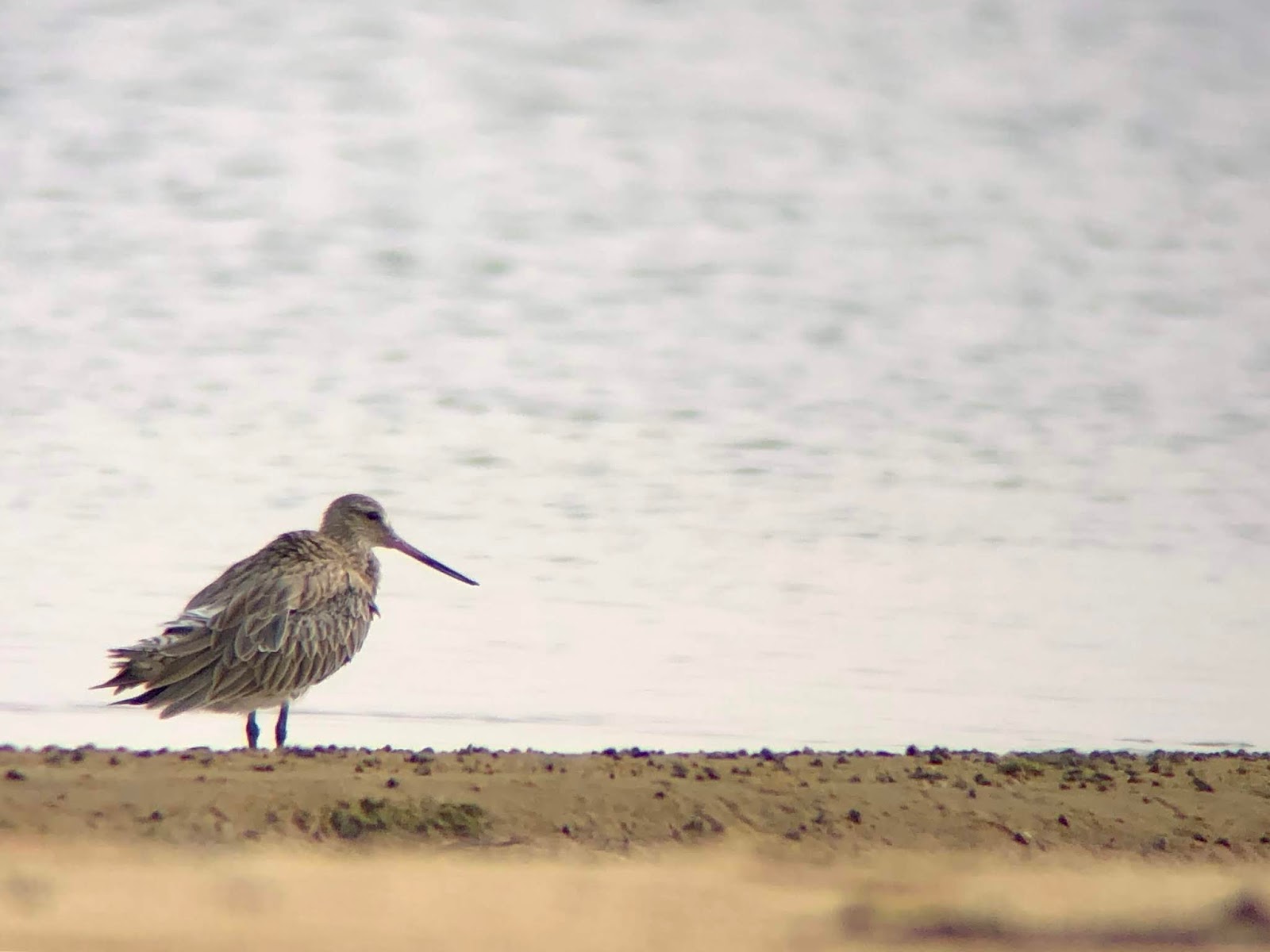

Bar-tailed Godwit, iPhone photo through Vortex Razor scope

Birding Kalpitiya - Part 1 Seabirds

Lesser Crested Tern, photo by Saranga
The morning of November 5th, shortly after I woke up, my husband surprised me that he wanted to take me to the beach when he got home from work, and to plan for 2 nights away. We had talked about visiting Kalpitiya, a western coastal town in Sri Lanka, later this month, but some recent reports of Orcas showing up inspired an impromptu vacation. We first arrived in Norochcholai and visited the Department of Wildlife Conservation office. Staff shared recent accounts of Spinner Dolphins and Orcas. They treated us to a delicious lunch while playing locally filmed videos of the dolphins and whales. I was definitely getting excited to be on the water!

We were the only two people on the beach!

We stayed at Ocean Wind Beach Resort, and across the road, another property managed by the same people offered a private beach for us to use! We spent the evening walking the beach, collecting shells, watching crabs, wading, and building a sandcastle under the moonlight.

There were dozens of these crabs running along the waves. Photo by Saranga.
We only saw one of this type of crab. Photo by Saranga.

The boat we had for the morning.
Early the next morning, we woke up to meet our boat at the beach property, which also offers dolphin watching tours. The small 6-seat boat was by far the smallest watercraft I’d ever been on in the ocean, and with the wind, I was a little nervous. Being the off-season for tourism and just the beginning of whale and dolphin season, we ended up with a private boat for the morning. 

The water wasn’t as smooth as it had been the previous days, and the wind direction had changed so there was a chance we wouldn’t get to see the dolphins. This became a reality as we spent more time at sea. After a while, we began to see small groups of 3-10 terns flying by or circling low over the water. We finally told the boat drivers that we’d be happy to stop and look at the birds the next time we found a group, since the dolphins didn’t seem to be around.

Small groups of birds turned into a feeding flock of roughly 150 terns! As we waited in the middle of the group, and circled back through the flock several times, we were able to identify 8 species of terns, two being life birds for both Saranga and myself! Then, we noticed a dark bird fly low over the water and land… we quickly got binoculars and our camera on the bird and identified it as a Wedge-tailed Shearwater! Another life bird for us both! Then another… and another! Altogether, 4 Wedge-tailed Shearwaters sat on the water and flew low to the water below the higher-flying terns.

Saranga's photo of one of the Wedge-tailed Shearwaters
Another Wedge-tailed Shearwater. Photo by Saranga.

Terns dove into the water all around our boat, performing incredible aerial displays. It was really a fun experience and we were quite happy ending the trip with 3 life birds and no dolphins. We may try to go back again on a day with better sea conditions, but who knows… we may not see any good birds that way!
 
Omeesha Beach Resort, where we enjoyed breakfast after the dolphin tour.


Here’s are list of the birds we saw at sea:

1 - Wedge-tailed Shearwater
2 - Sooty Tern
3 - Bridled Tern
4 - Gull-billed Tern
5 - Sandwich Tern
6 - Common Tern
7 - Whiskered Tern
8 - Great Crested Tern
9 - Lesser Crested Tern
10 - Blue-tailed Bee-eater (I know they migrate, but I was surprised to see a group of 6 bee-eaters at sea!)


Ready for Part 2 of our vacation! 

Monday, 28 October 2019

Sri Lanka Green Pit Viper


Sometimes in nature, I find it difficult to overcome intense emotional attachment with wildlife.

In September 2018, I traveled to Sri Lanka for the first time on a wildlife trip focused on the endemic snakes of the island (with Classic Travel and Wildside Nature Tours.) I had a favorite endemic lizard and skink picked out from the Reptiles of Sri Lanka book the moment I opened it. Choosing a most wanted snake was only slightly more of a challenge; of course, I wanted to see the iconic Indian (or Spectacled) Cobra. How could I resist the thrill of finding a Russell’s Viper or a Saw Scaled Viper… two of the deadliest snakes in Asia. I had also seen the hump-nosed vipers from Steve Irwin’s visit to Sri Lanka, so I definitely hoped to see those as well. One snake however, still called to me above the rest. Perhaps because it was the cover photo of the field guide, or perhaps because I can’t resist the gorgeous green, yellow, and black of an untouchable Sri Lanka Green Pit Viper.


Last year, in the mountains surrounding the city of Kandy, our group was out on a night hike in search of some locally endemic reptiles such as the Hump-nosed Lizard, which we were quickly successful at finding. My best friend Sandy spotted our first venomous snake of the trip, a Merrem’s Hump-nosed Viper. He was close and gorgeous. I remembered how dangerous this little snake was from watching Steve Irwin’s Crocodile Hunter episode filmed in Sri Lanka.

Sri Lanka Hump-nosed Lizard, or Lyre Head Lizard, an
 endemic. Photo from Kandy, September 2018.

Merrem's Hump-nosed Viper. Photoed in Kandy, September 2018

Moments later, through the darkness, a group member called out that they had a pit viper. My heart was racing. I found it hard to swallow as Sandy and I made our way towards the voices of our group. As we approached, the green seemed to glow in the night. I snapped this photo with shaking hands, just before someone noticed that the snake was trapped.

A baby Sri Lanka Green Pit Viper, endemic.
Photo in Kandy, September 2018.

It had somehow had the misfortune of being in the wrong place when a limb fell, nearly severing the body in two. Several of our group members were able to move the branch, revealing that the snake’s body was being held in one piece by a single strand of tissue. Snakes are tough critters and can survive some pretty remarkable injuries, but due to the severity and location of this particular injury, this youngster didn’t stand a chance. Still overcome by seeing my most-wanted snake, and the high energy rush to get up the hill to see it, I was crushed knowing it wouldn’t live. I couldn’t hold back tears as I watched it, just a baby, knowing it would soon die of a combination of its injury, starvation, and dehydration. The group left it atop a stick, where I knew it would suffer even more in the next day’s sun. I requested it be moved under some leaves, but I secretly hoped someone would end its suffering right there.

That was the one and only Sri Lanka Green Pit Viper we saw on that trip.

In March, I was back in Sri Lanka and hoped again to revisit the Green Pit Viper. Saranga and I visited several locations where they reside, but the heat and dry conditions weren’t optimal for snake activity.

It wasn’t to be.

Again, I’ve been in Sri Lanka since mid-August. The snake has constantly been in the back of my mind. In early October, my mom was visiting Sri Lanka to attend my wedding. We wanted to make sure she got the full wildlife experience, so we planned visits to Sinharaja Forest Reserve, Udawalawe National Park, and Wilpattu National park in addition to some other local birding spots. I know the damp habitat and streams of Sinharaja are perfect for Sri Lanka Green Pit Viper, so I once again mentioned to Saranga and the local park guide that I’d like to see one.

Saranga photographing a waterfall at Sinharaja, 10 October 2019.

I wasn’t expecting to see one, but just wanted to make it known, since most visitors aren’t interested in snakes like I am.

As we hiked, we saw some exceptional birds. 

Malabar Trogon, female. Photo by Saranga Dissanayaka.
Sinharaja Forest Reserve 10 October 2019

Sri Lanka Frogmouth, male and female. Sinharaja, 10 October 2019.

As we went off-trail with the guide to see the pair of Sri Lanka Frogmouths (above) the guide suddenly told me to stop before hopping over a stream. He pointed down, and there, where we had just crossed moments before, was a Lowland Hump-nosed Viper. Overly excited, I took some photos and shared the sighting with my mom and Saranga. Along with the birds and several Green Vine Snakes, I was already more than happy for the day.

Lowland Hump-nosed Viper, endemic. Sinharaja, 10 October 2019.

During our lunch break, mom, Saranga, and I cooled our feet in a stream while watching endemic fish and some interesting frogs and geckos. 

A cryptically colored gecko. Sinharaja 10 October 2019.

Our guide went down another trail before coming back to tell us he had seen a pit viper. I quickly strapped my boots and leech guards back on and grabbed my camera… leaving my bag and lunch behind and followed the guide. Again, my heart was racing as we walked, seemingly forever, up the trail. I felt sick to my stomach from excitement and remembering my last encounter. I quickly scanned every bit of stream and good-looking vegetation to try to spot a snake on my own while also trying to not lose the guide ahead of me.

Finally, he simply stopped and pointed. There it was. A Sri Lanka Green Pit Viper. Alive and healthy. It was using its prehensile tail to grasp a twig as it waited in a strike-ready position for any frog, tadpole, or fish to venture into its reach. I nearly cried as I snapped as many photos as I could from every angle I could without disturbing it. I used my cellphone, I used my point-and-shoot camera, and I even borrowed mom's phone for a few shots. 

Sri Lanka Green Pit Viper, hunting the Sinharaja Forest Reserve,
10 September 2019.

Saranga's photo of the Sri Lanka Green Pit Viper. Sinharaja, 10 October 2019.

Letting me get my fill of the beautiful animal in front of me, the guide waited several minutes before pointing out that he had also found a second one (and two Green Vine Snakes) nearby. The second one was just as alert yet oblivious to our presence. I starred through my 8x32 binoculars at close range to soak in every bit of detail that I could. Every scale, the loreal pits, the shape of its mouth, that distinctive triangle head leading to a narrow neck. The green. The flecks of yellow. The black. The intensity of its stare and focus on food….

The second Sri Lanka Green Pit Viper
Photo by Saranga Dissanayaka.

Sri Lanka Green Pit Viper

My cellphone picture of the second Sri Lanka Green Pit Viper

Tears come to my eyes again, just recalling the beauty of these snakes. In the moment of being in the presence of not one, but TWO Green Pit Vipers, I completely forgot to take pictures of the Green Vine Snakes, another favorite of mine, so I was thankful to encounter another during our hike out of the forest. 

Green Vine Snake. Sinharaja, 10 October 2019.

Needless to say, our guide got an extra tip for going above and beyond to find these snakes for me. He knew I wanted to see them, and he knew a trail where they like to feed. He went while we rested, quite a way out of the way to look for this one species for us. It turned out that he also remembered Saranga and me from our visit to Sinharaja in March. He invited us to his home for tea after our day’s adventure. The hospitality in Sri Lanka is truly unmatchable.  

My mom, Julie, me, Saranga, and our wonderful Forest Department guide


Thursday, 29 August 2019

Horton Plains National Park


We took a bus, an overcrowded train, and another bus on a day-and-a-half long journey from home to Nuwara Eliya last week. Leaving temperatures in the low-90s in Anuradhapura, we arrived on a misty and cool 58-degree evening in the mountains. 

A view from the bus as we passed through the mountains and tea plantations

We showered and layered on the clothing we brought and settled into our hotel room for the night. In the morning we would be leaving at 4:45AM to head to Horton Plains National Park… another hour away by tuk-tuk. The morning was misty and rainy, windy, and downright cold as we made our way to the park. Upon arrival, and seemingly on cue, the rain let up, and the wind settled. Making our way to the trail head, we met Lillie, a fellow birder from the United States.

Birding Horton Plains! - Photo by NS Dissanayaka

Horton Plains is a vast and unique park with open grasslands flanked by rainforest, high in the mountains. It’s the home to Leopards, the regionally endemic Bear Leaf-monkey, a subspecies or the Purple-faced Leaf-monkey, Sambar Deer, many regionally endemic birds, and several endemic lizards, including my favorite Rhino-horned Lizard. The climate, montane habitat, and wildlife are unlike anywhere else in Sri Lanka.


We started our nearly 6-mile trek through the grasslands to the famous Baker’s Falls, through the jungle, and on to the End of the World overlook. It didn’t take very long until Saranga pointed out a Blyth’s Pipit… a life bird! It’s #916 for the world, and #222 for Sri Lanka! Here’s a short photo-tour of Horton Plains National Park…

Sambar Deer - Photo by NS Dissanayaka
Tricolored Munia (Lonchura malacca)

Baker's Falls

Yellow-eared Bulbul (Pycnonotus penicillatus)
a Sri Lanka endemic - Photo by NS Dissanayaka


Cinereous Tit (Parus cinereus) - Photo by NS Dissanayaka

Saranga and me at the World's End overlook - Photo by L. Kline


World's End

Dark-fronted Babbler (Rhopocichla atriceps) - Photo by NS Dissanayaka

Photo by NS Dissanayaka


Saranga and me at Baker's Falls - Photo by K. Wijesinghe

All photos in this post are mine unless noted otherwise :) Thanks for reading! 
-Anna