Thursday, 31 May 2018

Wildlife Encounters in Florida

April 24, 2015


White Ibis
I just returned from a pretty amazing trip to Florida! This was my first *real* trip to Florida so it was pretty exciting for me! I have been to Florida two other times but both were visits to Disney World and attractions like the Weeki Wachee mermaid show and the Kennedy Space Station museum. Both times, I was well under 10 years old and I barely remember the trips... I definitely wasn't a birder yet, and we didn't visit any natural areas.

During this week-long trip, we drove and camped along the way through Florida to the keys. We camped at the Chassahowitzka River Campground, Lake Kissimmee State Park, and Curry Hammock State Park. We also visited Crystal River National Wildlife Refuge, Loxahatchee National Wildlife Refuge, Fort Zachary Taylor Historic State Park, and the Port Orange Causeway Park.

Green Iguana
Chassahowitzka wasn't especially interesting, as far as birds and wildlife diversity. However, we did find one of only two snake species we found on the trip: a Yellow Rat Snake. He was very pretty and after finding him, Ben and I walked along the roads near the campground to look for more snakes. Our only luck was a squished Ringneck Snake. On the way back into the campground, we heard some type of critter making a pretty loud racket behind a bush. As we shined a light over, a Nine-banded Armadillo quickly ran behind a tree!! It was the first Armadillo I had ever seen, and by the next day, they were added to the top of my list of favorite mammals!

Yellow Rat Snake saved from the road.

Sunday morning, we all woke up at 4:45am to get ready to head to the Crystal River area. We had booked spots on a boat to take us out to snorkel with manatees. I had never been snorkeling, and I wasn't sure I really wanted to get in the water with manatees at all, but I did want to see a manatee. I also figured that we would be able to see some interesting birds from the water. It ended up being really fun! We took turns snorkeling to see a total of four manatees, including a mother and 2-year old baby! Afterwards, our guide took us to a protected spring where the water was crystal clear and we were able to swim down a channel and see the spring. It was beautiful and we could see some neat fish! The water was clearer than where we snorkeled with the manatees so I was a little less nervous about it, and I really enjoyed it! I also saw my first two life birds of the trip: Fish Crows and Boat-tailed Grackles!

Crystal River

Ben with a Green Tree Frog that he found on the boat

Later that day after some resting and food, we drove on to camp at Lake Kissimmee State Park. Here, we found our second, and last live snake of the trip, a Southern Ringneck Snake. We were hoping that by picking the right habitat, we would find a Pygmy Rattlesnake, but we'll have to try again next time! Birding was nice at this campground. Northern Parulas were pretty abundant and a beautiful Summer Tanager sang and followed us around! At night, the bathhouse was covered in Mediterranean Geckos looking for insects near the lights! The next morning as we birded while looking for a dumpster, Ben and I spotted two Barred Owls hunting for frogs above a small pond!

A Barred Owl hunts for frogs

Limpkin at Loxahatchee National Wildlife Refuge. Photo by Ben Warner

Once we arrived in the keys, we set up camp at Curry Hammock State Park on Little Crawl Key. From our campsite, we took several early morning bird walks along the beach and mangrove trails. This yielded serveral life birds for both Ben and me, including Gray Kingbird, Black-whiskered Vireo, and White-crowned Pigeon!

Ruddy Turnstones

Along the beach, we enjoyed observing the Ruddy Turnstones foraging in detritus and the Reddish Egret foraging in the shallow waters. One interesting encounter was a Great White Heron attempting to eat an invasive Lionfish. During the drive to Florida, I looked through a book of reptiles and amphibians of the state, and hoped I would see a Curly-tailed Lizard, even though they aren't native.

Curly-tailed Lizard
One day, as I was walking to the shower house, I spotted on one the wooden ramp leading to the showers! I was so excited that I sat near it and waited for Ben to finish in the shower so I could share it with him. Thankfully, it stuck around so I could come back with my camera.

Reddish Egret
A Reddish Egret shades the water to spot prey
On April 21st, we drove to Key West to eat Key Lime Pie and visit the beach at Fort Zachary Taylor Historic State Park. When we first arrived, Ben and I went birding while the kids swam. It was HOT but we managed to see some great birds, both local and some passing through. My favorite were the Gray Kingbirds and Blue Grosbeaks! After we were too hot to continue birding, we decided to go snorkeling around some rocks. I absolutely loved seeing the colorful fish and interesting corals on the rocks. The most memorable were the Sergeant Major, or Damsel Fish and the Blue Parrotfish.

Birding Fort ZT Historic State Park 
The next day, back at Curry Hammock State Park, we went swimming. As we waded through the water, we spotted the most gorgeous young Spotted Eagle Ray! We quickly went back to the campsite to get snorkeling gear to see what else we might find in the water. We enjoyed more colorful fishes and interesting Cassiopia, or Upside-down Jellyfish. Unfortunately, I also got to experience the sting of the Cassiopia.

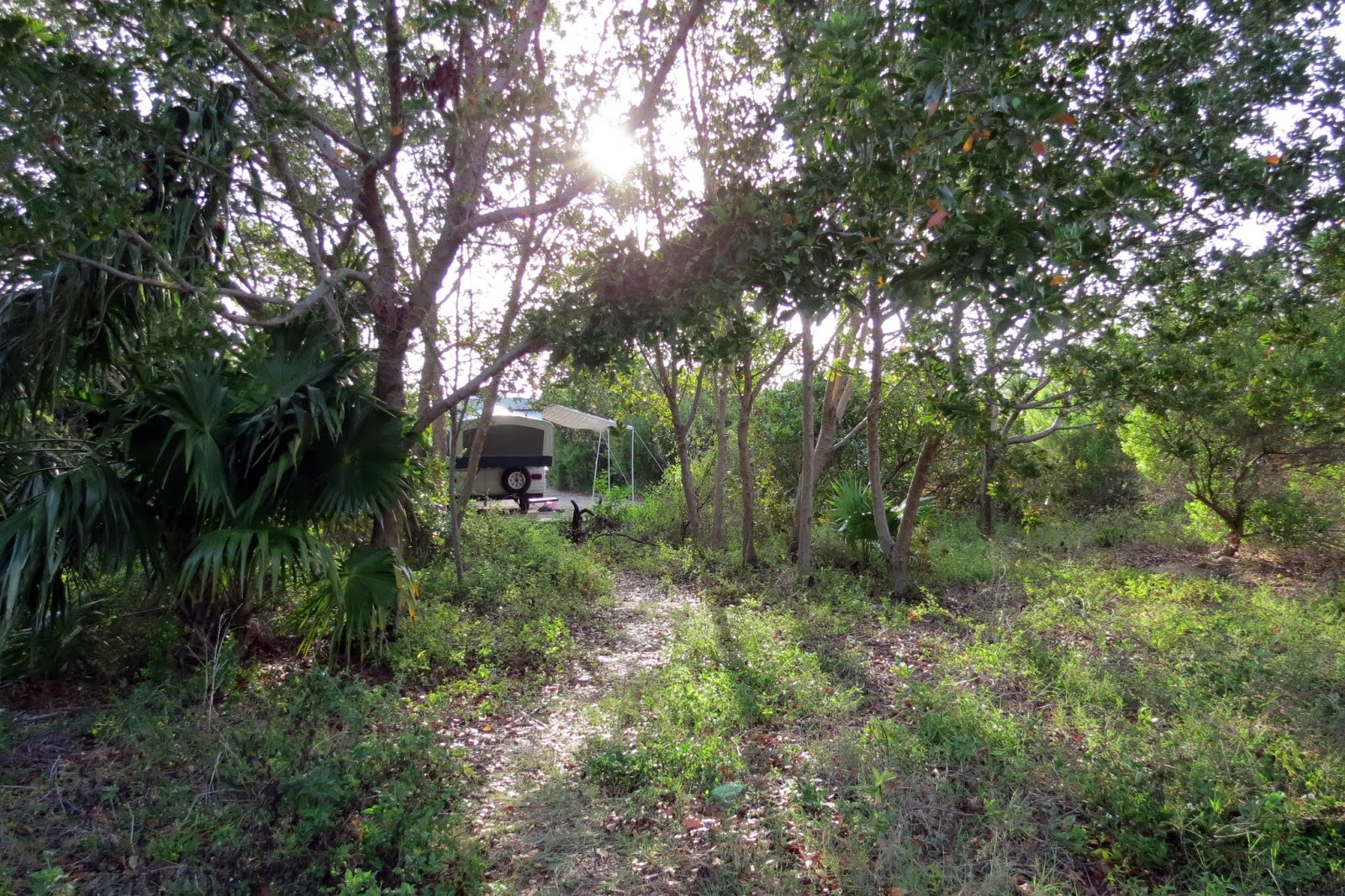
The view from behind our campsite at Curry Hammock State Park

On our way home, we stopped at the Port Orange Causeway Park. Here we got to watch an American Oystercatcher with babies feeding on a Horseshoe Crab. We also got this family photo. Much thanks to Matt and Kelsey for inviting us along on their roadtrip!


Below is a complete list of critters that we were able to identify!

Birds (*Life Birds)
*Mottled Duck
Blue-winged Teal
Lesser Scaup
Wild Turkey
Wood Stork
Magnificent Frigatebird
Double-crested Cormorant
Anhinga
American White Pelican
Brown Pelican
Great Blue Heron
Great White Heron (White morph of GBHE)
Yellow-crowned Night-Heron
Great Egret
Snowy Egret
Little Blue Heron
Tricolored Heron
Reddish Egret
Cattle Egret
Yellow-crowned Night-Heron
White Ibis
Glossy Ibis
Black Vulture
Turkey Vulture
Osprey
Swallow-tailed Kite
Bald Eagle
Red-shouldered Hawk
Purple Gallinule
Common Gallinule
Limpkin
Sandhill Crane
Black-necked Stilt
*American Oystercatcher
Black-bellied Plover
Semipalmated Plover
Killdeer
Spotted Sandpiper
Willet
Ruddy Turnstone
Sanderling
Dunlin
Least Sandpiper
Western Sandpiper
Short-billed Dowitcher
Bonaparte's Gull
Laughing Gull
Herring Gull
*Least Tern
Caspian Tern
Royal Tenr
Black Skimmer
Rock Pigeon
*White-crowned Pigeon
Eurasian Collared-Dove
*Common Ground-Dove
Mourning Dove
Yellow-billed Cuckoo
Barred Owl
Common Nighthawk
*Chuck-will's-widow
Chimney Swift
Belted Kingfisher
Red-bellied Woodpecker
Northern Flicker
Pileated Woodpecker
*Monk Parakeet
Great Crested Flycatcher
Eastern Kingbird
*Gray Kingbird
Loggerhead Shrike
White-eyed Vireo
*Black-whiskered Vireo
Blue Jay
American Crow
*Fish Crow
Northern Rough-winged Swallow
Purple Martin
Bank Swallow
Barn Swallow
Tufted Titmouse
Carolina Wren
Blue-gray Gnatcatcher
Gray-cheeked Thrush
American Robin
Gray Catbird
Northern Mockingbird
*Common Myna
European Starling
Ovenbird
Worm-eating Warbler
Northern Waterthrush
Black-and-white Warbler
Common Yellowthroat
American Redstart
Cape May Warbler
Northern Parula
Blackpoll Warbler
Black-throated Blue Warbler
Palm Warbler
Yellow-rumped Warbler
*Prairie Warbler
Chipping Sparrow
Summer Tanager
Northern Cardinal
Blue Grosbeak
Indigo Bunting
Red-winged Blackbird
Eastern Meadowlark
Common Grackle
*Boat-tailed Grackle
Brown-headed Cowbird
House Sparrow

Reptiles/Amphibians
Yellow Rat Snake
Southern Ringneck Snake
Oak Toad
Cuban Tree Frog
Fowler's Toad
Narrow-mouthed Frog
Florida Cricket Frog
Cuban Treefrog
Green Treefrog
Squirrel Treefrog
Pinewoods Treefrog
Cuban Brown Anole
Curly-tailed Lizard
Green Iguana
Six-lined Racerunner
Mediterranean Gecko
Southeastern Five-lined Skink
Broad-headed Skink
Gopher Tortoise

Fish/Mollusks/Crustaceans
Spotted Eagle Ray
Blue Land Crab
Bermuda Chub
Sergeant Major
Blue Parrotfish
Atlantic Needlefish
Cassiopea Jellyfish (Upside-down Jellyfish)
Conch
Atlantic Blue Crab
Blue Land Crab
Caribbean Hermit Crab
Marine Hermit Crab
Barnacles

Mammals
Manatee
Nine-banded Armadillo
Key Deer (endangered subspecies of White-tailed Deer)
White-tailed Deer

Monday, 28 May 2018

2018 Birdathon Big Day

Monday, May 14, 2018

The BenAnnaquits set off for our 3rd year of participation in the Columbus Audubon Birdathon! This year's Birdathon was extra exciting because we were testing out a new route. Our goal was to beat last year's total of 153 species. We started off at 11:00 PM Sunday night to head towards our starting destination in Southern Ohio. An hour later, our timer started and we rolled down the car windows, anxiously awaiting our first bird of the day. Gray Catbird! We continued towards Tranquility Wildlife Area, making several stops along grassy fields listening over the sounds of Cope's Gray Treefrogs and Blanchard's Cricket Frogs. We added Yellow-breasted Chat, Northern Mockingbird, and Henslow's Sparrow before arriving at our starting destination. As we quietly crept down the roads of the wildlife area, our main target began to call... a Chuck-will's-widow! Chuck-wills-widow was even a new state bird for me! (#331 for Ohio) Several Eastern Whip-poor-wills called all around us as we listen for a distant Barred Owl.

Clear Creek Metro Park. Photo by Anna Wittmer

We arrived at Clear Creek Metro Park before the dawn chorus started. An Eastern Whip-poor-will called into the silence of the night. As the birds woke up, we began our hike. A chorus of Wood Thrushes sang through the mist of the morning. Cerulean Warblers and Black-throated Green Warblers buzzed in the tree tops. Before long, we heard a Worm-eating Warbler, not far from the trail. It didn't take long before our team all got to see him as he sang repeatedly! Driving from one end of Clear Creek Metro Park to the other, we saw a beautiful Luna Moth flutter in front of us. Shortly after, Ben spotted a Milk Snake in the road. This has been a nemesis herp of mine for years! I jumped out to see it and help it across the road. I was thrilled to have this gorgeous guy in my hands for the first time!

Me with my lifer Milk Snake! Photo by Julie Wittmer

Milk Snake bellies. Photo by Julie Wittmer

Just seconds down the road, an Eastern Box Turtle crossed. Again I hopped out of the car to assist her crossing. We added several more species, including Yellow-billed Cuckoo, Pileated Woodpecker, Indigo Bunting, and Ruby-throated Hummingbird before continuing our journey north. Along the route, we added Turkey Vultures and Rock Pigeons.

Eastern Box Turtle crossing the road. Photo by Anna Wittmer

Upon arriving at Pickerington Ponds Metro Park at 9:20am, it was alreay getting rather warm. We quickly scoped a Barn Owl nesting site before tallying a White-eyed Vireo in the parking lot!

Our next stop was Bolton Field Airport. We found a patch of shade to scope the grasslands as we heard several Eastern Meadowlarks call. Turkey Vultures, Red-tailed Hawks, and a Cooper's Hawk swirled in the sky above. We heard Savannah Sparrows as we scanned for our main target. After a few minutes, we were preparing to leave when Ben spotted it: an Upland Sandpiper! We all grabbed quick views before jumping back into the Prius.

By the time we arrived at Battelle Darby Creek Metro Park, it was hot! 88 degrees is not ideal for wetland birding in the spring. We managed to add Sora and Virginia Rails, Common Gallinule, Ruddy Duck, Blue-winged Teal, Northern Shoveler, Hooded Merganser, Marsh Wren, and several other species, but missed the bitterns we were hoping for.

Photo by Julie Wittmer

The fields around Battelle Darby yielded Horned Larks, a Vesper Sparrow, and an American Pipit as we continued north. We soon realized we had made a fatal mistake and had left our food bag at home. We opted to stop by to pick it up and take a restroom stop rather than making several other stops for food or snacks throughout the day. We headed back towards home, which thankfully was mostly on the way to our next location anyway. On the way home on Interstate 270, the storms started rolling in. High winds, hail, and torrential downpours followed us home and we waited longer than we should have for the rains to let up before we left again for the 2.5 hour drive to Magee Marsh.

In the time it took us to drive north, the outside temperature had dropped 20 degrees. Birding Magee Marsh was FANTASTIC! We arrived to a rather large crowd all looking for a vagrant Black-throated Gray Warbler. I immediately ran into my bird-sister, Ashli and she informed us that the bird hadn't been very cooperative lately. We decided to give it a try but not spend too much time for one species. We added a few new warblers along the way such as Chestnut-sided Warbler before arriving to the largest group of people. Just as we stopped to wait, someone called out that she spotted it. We were a ways from the epicenter of the group, but we lucked out having this lovely female Black-throated Gray Warbler right out in the open where we could all easily admire her! We weaved our way through the crowd, briefly stopping to greet my bird-dad Kenn Kaufman who generously pledged a donation per species we found on our Big Day! We continued to add the rest of the expected warblers that we needed, including Black-throaed Blue Warbler, Myrtle Warbler, and Wilson's Warbler. We enjoyed incredible close-up views of a Canada Warbler before continuing on to find a Philadelphia Vireo, Olive-sided Flycatcher, and an Eastern Screech-Owl. We were surprised to observe a Sedge Wren foraging on the ground just inches off the edge of the boardwalk. Their intricate patterning was impressive to see that closely. We saw 23 species of warblers at Magee Marsh! There were so many birds everywhere we looked that it made it very difficult to pull ourselves away from the boardwalk to continue our Big Day.

Black-throated Gray Warbler at Magee Marsh. Photo by Rick Nirschl

Our next destination was a quick drive through the Ottawa National Wildlife Refuge Auto Tour. Our targets here were Black-necked Stilts, and any other shorebirds or waterfowl we could locate. We were not expecting to add a Rough-legged Hawk during our Big Day since they usually leave Ohio by late March or early April. Some other additions included Green Heron, American Wigeon, Common Tern, and Dunlin.

The Eastern Screech-Owl we saw at Magee Marsh
Photo by Chris Brown

A brief drive through Metzger Marsh yielded Cliff Swallows for the day before we arrived at Howard Marsh. Howard Marsh is an impressive 1000-acre wetland restoration project completed by the Toldeo Metroparks that just opened earlier this month. It has already been hosting a wide variety of migrant shorebirds, waterfowl, and waders, and quickly became the home of a nesting pair of Osprey. Getting late in the day, we were still able to aquire several new species! Dunlin were present in the hundreds and among them were 38 Short-billed Dowitchers and 2 Wilson's Phalaropes. We tallied Bonaparte's Gulls and a single Lesser Scaup before our departure.

The sun was getting low in the sky, but we had just enough time to get to Oak Openings Metropark before last light. As soon as we rolled down the windows, we could hear several American Woodcocks "peenting." A Wild Turkey called from a distance and a single Lark Sparrow sang his last bit of song before nightfall. We missed several species by arriving so late in the day but got lucky with these ones! Eastern Whip-poor-wills called at the third location of the day to start and end our Big Day.

As the night grew darker, we were off to Irwin Prairie State Nature Preserve. Several occasions of recent scouting offered a variety of rails, Wilson's Snipes, and more. Tonight, we accidentally flushed a single Song Sparrow from the edge of the boardwalk. We didn't detect a single species more, besides hundreds of Gray Tree Frogs, and a few Spring Peepers, and Western Chorus Frogs!

Our team was exhausted and opted to head home since we had to work the next morning. We didn't set any state records, but we did set a new record for our team! 158 species in a single day!!

Click HERE to contribute to our donations for Columbus Audubon! THANK YOU!!

Some Stats

Species of Warblers Observed: 30 Species
Species of Sparrows Observed: 12 Species
Total Species of Birds Observed: 158 Species
Number of Reptiles/Amphibians Observed: 16 Species
Number of Mammals Recorded: 9 Species
Miles Driven: 591 Miles
Miles Walked: 4.5 Miles
Counties Birded: 8 Counties
Total Hours Birding: 22.5 hours

Although I drive an eco-friendly Toyota Prius, I was feeling guilty about our carbon footprint during our Ohio Big Day. To help offset the damage, I donated to the Nature Conservancy in support of habitat restoration efforts and research into climate change solutions.

Meet the BenAnnaquits

Anna Wittmer - I formed the BenAnnaquits team with my husband, Ben Warner the first year we moved to Columbus together. I asked my mom, Julie Wittmer to join us and she has every year. We often try to include anyone else who is interested in joing us. This year, we were joined by my friend and newest coworker, Sarah Brown! Sarah has only been birding for a few months and was a great team member during our day! She added 56 lifers!


Me, Julie, and Ben

Sarah

Our Bird List

  1. Canada Goose
  2. Trumpeter Swan
  3. Blue-winged Teal
  4. Northern Shoveler
  5. Gadwall
  6. American Wigeon
  7. Mallard
  8. Lesser Scaup
  9. Hooded Merganser
  10. Ruddy Duck
  11. Ring-necked Pheasant
  12. Wild Turkey
  13. Pied-billed Grebe
  14. Double-crested Cormorant
  15. Great Blue Heron
  16. Great Egret
  17. Snowy Egret
  18. Green Heron
  19. Turkey Vulture
  20. Osprey
  21. Cooper's Hawk
  22. Bald Eagle
  23. Red-tailed Hawk
  24. Rough-legged Hawk
  25. Virginia Rail
  26. Sora
  27. Common Gallinule
  28. American Coot
  29. Sandhill Crane
  30. Black-necked Stilt
  31. Killdeer
  32. Upland Sandpiper
  33. Dunlin
  34. Short-billed Dowitcher
  35. American Woodcock
  36. Wilson's Phalarope
  37. Spotted Sandpiper
  38. Solitary Sandpiper
  39. Greater Yellowlegs
  40. Lesser Yellowlegs
  41. Bonaparte's Gull
  42. Ring-billed Gull
  43. Herring Gull
  44. Caspian Tern
  45. Common Tern
  46. Rock Pigeon
  47. Mourning Dove
  48. Yellow-billed Cuckoo
  49. Barn Owl
  50. Eastern Screech-Owl
  51. Barred Owl
  52. Chuck-will's-widow
  53. Eastern Whip-poor-will
  54. Chimney Swift
  55. Ruby-throated Hummingbird
  56. Belted Kingfisher
  57. Red-bellied Woodpecker
  58. Northern Flicker
  59. Pileated Woodpecker
  60. American Kestrel
  61. Olive-sided Flycatcher
  62. Eastern Wood-Pewee
  63. Acadian Flycatcher
  64. Willow Flycatcher
  65. Least Flycatcher
  66. Eastern Phoebe
  67. Great Crested Flycatcher
  68. Eastern Kingbird
  69. White-eyed Vireo
  70. Yellow-throated Vireo
  71. Blue-headed Vireo
  72. Philadelphia Vireo
  73. Warbling Vireo
  74. Red-eyed Vireo
  75. Blue Jay
  76. American Crow
  77. Horned Lark
  78. Northern Rough-winged Swallow
  79. Purple Martin
  80. Tree Swallow
  81. Barn Swallow
  82. Cliff Swallow
  83. Carolina Chickadee
  84. Black-capped Chickadee
  85. Tufted Titmouse
  86. White-breasted Nuthatch
  87. House Wren
  88. Sedge Wren
  89. Marsh Wren
  90. Carolina Wren
  91. Blue-gray Gnatcatcher
  92. Eastern Bluebird
  93. Veery
  94. Gray-cheeked Thrush
  95. Swainson's Thrush
  96. Wood Thrush
  97. American Robin
  98. Gray Catbird
  99. Brown Thrasher
  100. Northern Mockingbird
  101. European Starling
  102. American Pipit
  103. Cedar Waxwing
  104. Ovenbird
  105. Worm-eating Warbler
  106. Louisiana Waterthrush
  107. Northern Waterthrush
  108. Blue-winged Warbler
  109. Black-and-white Warbler
  110. Prothonotary Warbler
  111. Tennessee Warbler
  112. Nashville Warbler
  113. Kentucky Warbler
  114. Common Yellowthroat
  115. Hooded Warbler
  116. American Redstart
  117. Cape May Warbler
  118. Cerulean Warbler
  119. Northern Parula
  120. Magnolia Warbler
  121. Bay-breasted Warbler
  122. Blackburnian Warbler
  123. Yellow Warbler
  124. Chestnut-sided Warbler
  125. Blackpoll Warbler
  126. Black-throated Blue Warbler
  127. Palm Warbler
  128. Yellow-rumped Warbler
  129. Yellow-throated Warbler
  130. Black-throated Gray Warbler
  131. Black-throated Green Warbler
  132. Canada Warbler 
  133. Wilson's Warbler
  134. Grasshopper Sparrow
  135. Henslow's Sparrow
  136. Chipping Sparrow
  137. Field Sparrow
  138. Lark Sparrow
  139. White-crowned Sparrow
  140. Vesper Sparrow
  141. Savannah Sparrow
  142. Song Sparrow
  143. Lincoln's Sparrow
  144. Swamp Sparrow
  145. Eastern Towhee
  146. Yellow-breasted Chat
  147. Scarlet Tanager
  148. Northern Cardinal
  149. Rose-breasted Grosbeak
  150. Indigo Bunting
  151. Eastern Meadowlark
  152. Baltimore Oriole
  153. Red-winged Blackbird
  154. Brown-headed Cowbird
  155. Common Grackle
  156. House Finch
  157. American Goldfinch
  158. House Sparrow

Our Herp List

  1. Cope's Gray Tree Frog
  2. Gray Tree Frog
  3. Leopard Frog
  4. Blanchard's Cricket Frog
  5. Green Frog
  6. Bull Frog
  7. Spring Peeper
  8. Western Chorus Frog
  9. Fowler's Toad
  10. American Toad
  11. Red Eft (Red-spotted Newt)
  12. Milk Snake
  13. Box Turtle
  14. Midland Painted Turtle
  15. Blanding's Turtle
  16. Map Turtle
Our Mammal List
  1. Virginia OPossum
  2. Eastern Cottontail
  3. Eastern White-tailed Deer
  4. Raccoon
  5. Gray Squirrel
  6. Fox Squirrel
  7. Red Squirrel
  8. Eastern Chipmunk
  9. Muskrat

Sunday, 27 May 2018

Birds of Mohican State Park

Last Monday, I led the Birds of Mohican field trip for Columbus Audubon. The 5,635 acres of Mohican State Park and Mohican State Forest are the nesting grounds for nearly 20 species of warblers, and several other more northern nesters like Winter Wren, Hermit Thrush, and Blue-headed Vireo.

We arrived at Mohican's Covered Bridge around 8 AM and immediately started hearing several of our target birds: Cerulean Warbler and Louisiana Waterthrush! It was a beautiful cool spring morning as we started off along the river. It wasn't long before we heard a Canada Warbler. We waited around and got a few brief glimpses, but he wasn't very cooperative. We decided to move on as we heard several Cerulean Warblers and Veerys singing all around us! Before long, we spotted a Louisana Waterthrush along the river bank. As we watched it bobbing its tail and fee ding, we heard a Hooded Warbler. We looked up to see him perched right out in the open about 15 feet above the trail! We all had incredible looks at this gorgeous male warbler as he sang and sang to attract a mate and let others know that the territory was occupied. It wasn't long into our walk when road construction drowned out the bird songs and literally blocked our path so we turned around and opted to hike the trail to Lyons Falls.

Scanning the river for birds, trout, and softshell turtles

The trail to Lyons Falls is stunning, ascending along the bank of the river and winding into the forest. As if the hike alone isn't worth it, the birds really treated us well. Throughout the hike we had great comparison views of Acadian Flycatchers, Eastern Wood-Pewees, and Eastern Phoebes. We watched the interactions between a pair of Cerulean Warblers, and spotted a beautiful Yellow-throated Warbler high in an American Sycamore tree.

The trail to Lyons Falls

As we moved along the stream running from the falls, a Louisiana Waterthrush sang as we flipped some rocks to discover a variety of beautiful salamanders including an adult and two juvenile Northern Spring Salamanders, several Two-lined Salamanders, and several Dusky Salamanders, including a couple in their larval state!

Northern Two-lined Salamander 

Northern Spring Salamander

Lyons Falls

After admiring Lyons Falls and the sandstone structure, we hiked back down the trail and had even more spectacular bird encounters. At one point, we spotted a Veery and a Gray-cheeked Thrush in the trail ahead. As everyone tried to get on the birds, they flew off. As we approached slowly, the Veery was sitting just off trail. We watched it at eye-level just 10 feet off the trail as it softly whispered its song and did its "veer" call. I had spent a while enjoying the Veery when something caught my eye on the opposite side of the trail. Right in front of us was a gorgeous Blue-headed Vireo. Just as close and low to the ground as the Veery! We lucked out with more up-close looks at an incredible bird.

A view of the Sandstone cliffs at Mohican State Park

As we finished our hike back at the covered bridge, a few of us decided to hit the restrooms before we headed out for our picnic lunch. On the way, we spotted a Yellow-billed Cuckoo just off the path... a life bird for some and great views for all! We decided to have lunch at the Discovery Forest to get away from the road construction noise at the covered bridge. It was nice that we did because we were able to add Ovenbird and Blackburnian Warbler to our trip list. We also got to share the lunch space with three baby Eastern Phoebes whose nest was built in the picnic shelter!

Eastern Phoebe nestlings

In all, it was a wonderful trip! I hope you'll have an opportunity to visit this incredible Ohio park.

View our species checklist, by clicking here.

Exploring the stream
Photo by Sheila M. Fagan. 

Friday, 26 May 2017

2017 Ohio Big Day

Bay-breasted Warbler - Photo by Dylan Vasapolli

02:00 16 May 2017
: We grabbed our binoculars and headed to our already packed vehicle. Our team, the Benannaquits, was off to beat last year's Columbus Audubon Big Day of 144 species on nearly the same date. Our route was similar but slightly revised, and our team gained an additional member. This year in addition to my mom, Julie, and my husband, Ben, we also had Dylan, our friend and a Birding Ecotours guide from South Africa, along for the day. A great advantage that we had this year was the opportunity for myself, Ben and Dylan to spend a good amount of time scouting many of our Big Day stops, during the Biggest Week in American Birding!

Our first bird of the day, en route to our first official stop was an American Robin.

05:02 We arrived in the Oak Openings region just in time for a full dawn chorus. As we sifted through the sounds of Grasshopper Sparrows, Common Yellowthroats, and American Woodcocks, we heard three distant calls that we were not expecting! The first was the low hoot of a Great Horned Owl! Next was an Eastern Whip-poor-will, and finally, and probably the most unexpected was a King Rail calling from a wet corner of the grassland!

We continued through several other hotspots within Oak Openings Preserve Metropark. We added our likely targets, such as Lark Sparrow, Henslow's Sparrow, Summer Tanager, and Red-headed Woodpecker. Among our highlights of Oak Openings were a singing Brown Creeper and Prairie Warbler! We ended our time at Oak Openings with all of the woodpecker species we would have for the day and a total of 77 species!

Brown Creeper - Photo by D. Vasapolli

We continued north, stopping at several of Toledo's fantastic parks, including Irwin Prairie State Nature Preserve, Secor Metropark, and Pearson Metropark. We were able to add a staked-out Louisiana Waterthrush and Hooded Warbler to our total!

While driving through Irwin Prairie, Julie spotted a bird perched atop a dead snag over the marsh. The lighting was poor as it had just started to rain, but there was no mistaking a Wilson's Snipe high above the wetland and calling Sora!

Wilson's Snipe at Irwin Prairie - Photo by D. Vasapolli

Julie, Dylan, and Ben enjoying an Eastern Screech-Owl
11:22 We made it to the Lake Erie coast! Our first stop along the lake was Maumee Bay State Park. We visited several locations within the park, quickly increasing our list with several species of gulls, terns, and swallows, a Ruddy Turnstone, Eastern Screech-Owl, and more! While we were in the lodge parking lot, we looked up to see a kettle of raptors migrating! 12 Broad-winged Hawks, 8 Turkey Vultures and a Bald Eagle swirled high in the sky above us!

Continuing our journey east along the coast, we stopped at a flooded field to find good numbers of Dunlin and Semipalmated Plovers, but not the species diversity we were hoping for.

By now, it was already starting to warm up beyond what we were hoping for. We arrived at Metzger Marsh. Several of our target birds were more difficult to find than we had anticipated, or worse, we couldn't find them at all. We finally managed a distant view of a Common Gallinule, and a single Pied-billed Grebe. The Least Bittern we had hoped for, and had previously heard and seen remained silently hidden in the cattails.


Eastern Screech-Owl - Photo by Ben Warner

13:43
 The Warbler Capital of the World! We arrived at the Magee Marsh boardwalk, and it was rather hot. On top of the heat, we were all feeling a bit sleepy, so perhaps we spent too much time at this stop. As we birded, we picked up several new warblers for the day, such as Wilson's Warbler and Black-throated Blue Warbler. The boardwalk was crowded with birders still on their post-Biggest Week buzz. Along the way, we bumped into Jen Brumfield, leading a group of Cleveland-area birders. Ben asked if she had seen a few of our target species and she directed us to where she had seen an Olive-sided Flycatcher. Sure enough, we finished the first loop and Ben looked up to see not one, but TWO Olive-sided Flycatchers perched high! Thanks Jen!

A bit further down our walk, we came across this Protonotary Warbler enjoying a nice snack!

Prothonotary Warbler at Magee Marsh - Photo by D. Vasapolli
Just moments later, we came across a Common Nighthawk resting on a limb, then a Black-crowned Night-Heron foraging along the back side of the boardwalk! As we continued along, Dylan heard a bird calling that we had missed earlier in the morning: Sandhill Crane! We had tallied 11 species of warblers when we left he boardwalk. We checked the beach and as we were leaving, Dylan and I noticed a Lesser Black-backed Gull!

Napping Common Nighthawk - Photo by D. Vasapolli
After leaving Magee Marsh, we continued east along the lake. Our next new bird flew across Route 2 in front of the vehicle... Snowy Egret!

16:48 Pipe Creek was our next stop, and we successfully added two staked out waterfowl species: Greater Scaup and a Ring-necked Duck! We quickly walked the loop hoping to hear rails or bitterns (and also hoping to find a Fox Snake!) We didn't have much luck, but we did see several Northern Water Snakes and as we neared the start of the middle dike, we heard and briefly saw a Virginia Rail!!

Continuing east, we made a brief stop to Huron Pier, where a Black-headed Gull had been seen throughout the previous week. It would have been a life bird for me, but not today. The stop wasn't a total dip though, because we added Mute Swans to our list for the day.

We jumped back into the van for the long drive to our next stop. We needed to head south to pick up some other species such as Cerulean Warbler, Carolina Chickadee, Worm-eating Warbler, Kentucky Warbler, Veery and Winter Wren.

20:22 It was getting close to dark when we arrived at Mohican State Park. As we drove in, the evening chorus was in full swing! We were certain we would be able to easily add at least 6-8 new birds. A Wild Turkey darted across the road and a chorus of Veerys greeted us! Then we were unpleasantly greeted by a "Road Closed" sign! In order to get to the area we wanted, we would have to double back, then take a longer route around the Pleasant Hill Dam and back into the park from the other side. We were quickly losing light but we continued along. By the time we reached our destination, many of the birds had stopped singing for the night. No signs of the summer resident Cerulean Warblers or Worm-eaters. Not even a chickadee. We hiked along the river listening for a late Winter Wren, and still nothing. As we headed back to the car, Dylan stopped behind us. He heard a noise and as he shined his flashlight up, a Barred Owl peered back down at us!

21:30 We finished our official birding for the day and just had a few remaining stops, to drop off Julie in Lexington, Ohio, and then continue the trek back to Columbus. By the time we got back home, we had been on the road for a total of 22 hours and we tallied an exciting 153 species for he day! Now starts the planning for our 2018 Columbus Audubon Big Day with a goal of 150+ (hopefully beating our current record!)

Black-thoated Green Warbler - Photo by D. Vasapolli
If you enjoyed our story, please consider supporting our efforts by donating to Columbus Audubon. Bird-a-thon monies raised will go to local conservation and conservation education efforts, as well as supporting the Central Ohio chapter of the Ohio Young Birders Club! Click Here to Support the Benannaquits!

Thank you!


Here's our complete Big Day list:
  1. Canada Goose
  2. Mute Swan
  3. Trumpeter Swan
  4. Wood Duck
  5. Mallard
  6. Ring-necked Duck
  7. Greater Scaup
  8. Hooded Merganser
  9. Wild Turkey
  10. Pied-billed Grebe
  11. Double-crested Cormorant
  12. Great Blue Heron
  13. Great Egret
  14. Snowy Egret
  15. Green Heron
  16. Black-crowned Night-Heron
  17. Turkey Vulture
  18. Osprey
  19. Bald Eagle
  20. Cooper's Hawk
  21. Broad-winged Hawk
  22. Red-tailed Hawk
  23. King Rail
  24. Virginia Rail
  25. Sora
  26. Common Gallinule
  27. American Coot
  28. Sandhill Crane
  29. Semipalmated Plover
  30. Killdeer
  31. Spotted Sandpiper
  32. Solitary Sandpiper
  33. Ruddy Turnstone
  34. Dunlin
  35. Least Sandpiper
  36. Wilson's Snipe
  37. American Woodcock
  38. Ring-billed Gull
  39. Herring Gull
  40. Lesser Black-backed Gull
  41. Caspian Tern
  42. Common Tern
  43. Forster's Tern
  44. Rock Pigeon
  45. Mourning Dove
  46. Yellow-billed Cuckoo
  47. Eastern Screech-Owl
  48. Great Horned Owl
  49. Barred Owl
  50. Common Nighthawk
  51. Eastern Whip-poor-will
  52. Chimney Swift
  53. Ruby-throated Hummingbird
  54. Red-headed Woodpecker
  55. Red-bellied Woodpecker
  56. Downy Woodpecker
  57. Hairy Woodpecker
  58. Yellow-shafted Flicker
  59. Pileated Woodpecker
  60. American Kestrel
  61. Olive-sided Flycatcher
  62. Eastern Wood-Pewee
  63. Acadian Flycatcher
  64. Alder Flycatcher
  65. Willow Flycatcher
  66. Least Flycatcher
  67. Eastern Phoebe
  68. Great Crested Flycatcher
  69. Eastern Kingbird
  70. White-eyed Vireo
  71. Yellow-throated Vireo
  72. Warbling Vireo
  73. Philadelphia Vireo
  74. Red-eyed Vireo
  75. Blue Jay
  76. American Crow
  77. Horned Lark
  78. Purple Martin
  79. Tree Swallow
  80. Northern Rough-winged Swallow
  81. Bank Swallow
  82. Cliff Swallow
  83. Barn Swallow
  84. Black-capped Chickadee
  85. Tufted Titmouse
  86. White-breasted Nuthatch
  87. Red-breasted Nuthatch
  88. Brown Creeper
  89. House Wren
  90. Marsh Wren
  91. Carolina Wren
  92. Blue-gray Gnatcatcher
  93. Eastern Bluebird
  94. Veery
  95. Swainson's Thrush
  96. Wood Thrush
  97. American Robin
  98. Gray Catbird
  99. Brown Thrasher
  100. European Starling
  101. Cedar Waxwing
  102. Ovenbird
  103. Louisiana Waterthrush
  104. Blue-winged Warbler
  105. Black-and-white Warbler
  106. Prothonotary Warbler
  107. Tennessee Warbler
  108. Nashville Warbler
  109. Common Yellowthroat
  110. Hooded Warbler
  111. American Redstart
  112. Cape May Warbler
  113. Northern Parula
  114. Magnolia Warbler
  115. Bay-breasted Warbler
  116. Blackburnian Warbler
  117. Yellow Warbler
  118. Chestnut-sided Warbler
  119. Blackpoll Warbler
  120. Black-throated Blue Warbler
  121. Pine Warbler
  122. Yellow-rumped (Myrtle) Warbler
  123. Yellow-throated Warbler
  124. Prairie Warbler
  125. Black-throated Green Warbler
  126. Canada Warbler
  127. Wilson's Warbler
  128. Yellow-breasted Chat
  129. Eastern Towhee
  130. Chipping Sparrow
  131. Field Sparrow
  132. Lark Sparrow
  133. Savannah Sparrow
  134. Grasshopper Sparrow
  135. Henslow's Sparrow
  136. Song Sparrow
  137. Lincoln's Sparrow
  138. Swamp Sparrow
  139. White-throated Sparrow
  140. White-crowned Sparrow
  141. Summer Tanager
  142. Scarlet Tanager
  143. Northern Cardinal
  144. Rose-breasted Grosbeak
  145. Indigo Bunting
  146. Red-winged Blackbird
  147. Eastern Meadowlark
  148. Common Grackle
  149. Brown-headed Cowbird
  150. Orchard Oriole
  151. Baltimore Oriole
  152. American Goldfinch
  153. House Sparrow


Saturday, 13 May 2017

A Kind-of Big Day

This year during Biggest Week in American Birding, one of the field trips that I co-led with Ben was a Big Day van trip on May 12th. Starting at 6AM, we had a full 9 hours to bird, leaving from the Maumee Bay State Park Lodge. The only rules, basically, were that we could not visit the Magee Marsh Boardwalk, and we have to be back by 3PM. Our van was full with 10 participants in  addition to Ben and myself. As a team, we set some ground rules: 1)Birds had to be seen or heard by at least one guide and at least 3 participants in order to be counted, and 2)We would get birds as quickly as possible unless it was a Life Bird for anyone, then we would try to get the person on their life bird for a decent look.

We started the morning at Oak Openings Metropark where we got our woodpeckers out of the way for the day! Red-headed, Red-bellied, Downy, Hairy, Pileated and Northern Flicker all in under 2 hours! We picked up 11 species of warblers and had a good start on sparrows with Henslow's Sparrow, Lark Sparrow, Chipping, Field, Song, White-crowned and White-throated, along with Eastern Towhee! Unfortunately, we were unable to refind 4 species that we had the previous day: Black Vulture, Wild Turkey, Cerulean Warbler, and Clay-colored Sparrow.

Stop #2 was nearby at the Wilkens Rd and Sager intersection, always a reliable grassland for Grasshopper Sparrow and Eastern Meadowlark, and it didn't disappoint! In addition, we has Blue-winged Warbler and Savannah Sparrow!

Next we drove through Irwin Prairie on our way to Secor Metropark, without even stopping, we added Brown Thrasher, Turkey Vultures and Sandhill Cranes! Secor was good to us. At the entrance, a Louisiana Waterthrush was heard calling, which is fairly unusual for the area! We also added Cooper's and Broad-winged Hawks, Ruby-throated Hummingbird, Orange-crowned Warbler, Hooded Warbler, and Wood Thrush!

We saw our only Rock Pigeon of the day en route to Pearson Metropark. We were lucky enough to spot a Sora walking along the edge of some reeds by one of the parking lots. Amazingly all 10 participants were able to SEE a Sora! It was a life bird for most of them! We picked up several more species for the day including Marsh Wrens, Sharp-shinned Hawk, and Northern Parula.

Our next stop was Metzger Marsh where some of our new birds included Cliff Swallow, Caspian Terns, Common Gallinule, Trumpeter Swan, and Pied-billed Grebe! We didn't stay long before we were off to the Krause/Stange Observation Tower of ONWR. We quickly added Dunlin, Eastern Kingbird and Lesser Yellowlegs before piling back into the van and returning to Maumee Bay State Park. By this time, we had already reached 100 species and we had less than 30 minutes remaining. We hurried down the boardwalk behind the nature center in search of a few key birds. A very cooperative Eastern Screech-Owl, Veery, and nesting Purple Martins made 103 possible!

The best part of the day was getting all 10 participants on life birds throughout the day!

There were a few birds throughout the day that Ben and I had that we couldn't get enough other participants on, like Horned Larks and Black-and-white Warbler. After our trip ended, we continued birding and added several more species to our personal day lists, including Osprey, Great Black-backed Gull, Bonaparte's Gulls, Red-breasted Merganser, Wild Turkey, Common Terns, and maybe a few others.

The Big Day van trip, and other field trips we led during Biggest Week were good for scouting out birds for our annual Columbus Audubon Bird-a-thon Big Day that we will be completing this Tuesday, May 16! Our goal is to beat last year's total of 144 species. Our team, the BenAnnaquits, will include my mom, Julie and our friend Dylan from South Africa. If you'd like to donate in our name, visit this link: https://columbusaudubon.org/groups/birdathon/columbus-audubon-birdathon-support/

Wednesday, 19 April 2017

Red River Gorge

Wildcat Creek
This weekend, Ben and I decided to head south for a quick adventure of early spring migration birding, hiking, a bit of rock climbing, and our first camping of the year! The Red River Gorge in Kentucky is one of Ben's favorite climbing areas and the forest is beautiful so I always enjoy going. Before we left, I found a book of hikes in the region and picked one that was a decent distance and provided good habitat for the birds I wanted to see.

As soon as we arrived in the familiar area of the Red, we stopped for a restroom break. Immediately upon opening the car doors, we heard a Louisiana Waterthrush! Then a Hooded Warbler, Worm-eating Warbler, Northern Parula, and a Black-and-white Warbler! I forgot all about the restroom and walked along the edge parking lot bordering a wooded ravine. Two Ruby-throated Hummingbirds fought over a branch just feet away from me as I listened to a Brown Thrasher singing away and even including an Eastern Bluebird chortle in his repertoire! In 15 minutes, I had added 5 new species to my year list!


We finished the drive to the trailhead of our selected hike: The Swift Camp Creek--Wildcat Loop. The supposed 5.3 mile hike (which turned out to be 7 miles) led us through deciduous and pine forest, along rocky cliffs and into the ravine to a stream, over a 456 ft. elevation change. Warblers were abundant! I could hardly keep a count of the numbers of Black-throated Green Warblers, Black-and-white Warblers, and Northern Parulas we saw and heard along the way! After about a mile and a half of hiking, we found ourselves on a trail between a rocky wall and a ravine full of rhododendrons when Ben heard a Swainson's Warbler!
We waited and listened as he got closer, further away, then nearly beside us! He jumped out on a branch right in front of me and I got an exceptional look at him for maybe 3 full seconds before he was gone again, deep within the brush. We waited around to see if we could get another look but he seemed to be hiding for good.

Along the way, the wildflowers were fantastic! Red Trillium, Rue Anemone, Wild Blue Phlox, Halberd-leaf Yellow Violet, Wild Geranium, Dwarf Iris, and more!  If I would have stopped to get photos of all of the beautiful and unique flowers we saw, it may have taken us twice as long to finish our hike! But some, I just couldn't resist! Here are a few of my favorites:

Red Trillium 

Foam Flower


 As we hiked on, several species of birds seemed curious and watched us from the edge of the trail. We had stellar looks at a Hooded Warbler, several Black-and-white Warblers and a Blue-headed Vireo! Around the 5th mile, we heard another Swainson's Warbler and this time we both got to see it!

We finished our hike before sunset and headed to Miguel's for dinner and to camp for the night. We ordered our favorite pizza with black beans, mango salsa, green peppers and spinach before selecting a spot to set up our tent. Along the way we heard Pickerel Frogs, a Bullfrog and quite a few Spring Peepers calling. Exhausted from the hike, I fell asleep quickly.  At 6 AM, I awoke to a familiar and exciting sound. an Eastern Whip-poor-will calling from the dark skies above our tent! I tried to fall asleep again as the Chipping Sparrows, Northern Parulas, American Robins, White-throated Sparrows, Red-headed Woodpeckers, and Brown Thrashers all began to wake up around us.


Our plans for our second day in the gorge were a bit different than the first. While we were still hoping to see more migrant birds, our goal for the day was to get in some rock climbing! Ben is a skilled climber and really enjoys getting outdoors to climb. I, on the other hand, have a slight fear of heights, and get anxious while climbing. I still enjoy the hikes to the crags, the wildlife we see along the way, the peacefulness of the forest, and the view from the top! My favorite thing is to get to the top of a route and look down over the valley and hope to see a Turkey Vulture or a Black Vulture!

The weather for our weekend getaway was perfect and I felt rejuvenated and ready to start back into the work week. For me, hiking 7 miles and birding is much more relaxing than lounging around at home.

In all, we saw 13 new year birds on our trip! Broad-winged Hawk, Ruby-throated Hummingbird, Worm-eating Warbler, Black-and-white Warbler, Northern Parula, Hooded Warbler, Blue-headed Vireo, Ovenbird, Swainson's Warbler, Eastern Whip-poor-will, Yellow-throated Vireo, Scarlet Tanager, and White-eyed Vireo!

A few more pictures from the weekend:

My favorite wildflower: Wild Columbine

Pleasing Fungus Beetle

Red Eft

After climbing!

My lovely husband watching a Blue-headed Vireo on the Wildcat Trail